gpu
 10:58
DON'T Buy a Used Mining GPU! - $h!t Manufacturers Say
3.7M views • 5 years ago
Linus Tech Tips
Linus Tech Tips looks at whether buying a used GPU that was previously used for crypto mining is a good idea, as miners prepare to sell off cards. The video discusses how mining affects wear on cards and what to watch for.
 12:36
Why PlayStation 1 Graphics Warped and Wobbled so much | MVG
2.3M views • 6 years ago
Modern Vintage Gamer
Modern Vintage Gamer explains why PlayStation 1 graphics warped and jittered, comparing it with the Nintendo 64. The causes are affine texture mapping and the lack of sub-pixel vertex precision.
Topic match · Computer graphics & rendering 24:26
The Beauty of Bézier Curves
2.2M views • 5 years ago
Freya Holmér
Freya Holmer explains how Bezier curves work, from the helper-line construction to their uses in animation, text rendering and shapes. It uses visuals from her Unity Shapes plugin and was a SoME1 contest winner.
Topic match · Computer graphics & rendering 1:13:50
The Continuity of Splines
1.9M views • 3 years ago
Freya Holmér
Freya Holmer's 74-minute video essay on splines, covering Bezier curves, B-splines, derivatives and the different levels of continuity (C0, C1, C2), built with custom animation tools. She notes she did not cover non-uniform splines.
Topic match · Computer graphics & rendering 11:27
CGA Graphics - Not as bad as you thought!
2.4M views • 10 years ago
The 8-Bit Guy
The 8-Bit Guy covers IBM's 1981 CGA graphics system, including how composite output and artifacting produced extra colors beyond the nominal palette. He argues CGA looked better in period than it does on RGB monitors.
Topic match · Computer architecture & CPUs 21:42
Future Computers Will Be Radically Different (Analog Computing)
13.2M views • 4 years ago
Veritasium
Veritasium explains why analog computing may suit AI workloads, covering old analog computers, The Analog Thing and Mythic's analog chips that use flash memory for neural network inference. It argues digital hardware is hitting limits.
Topic match · Computer architecture & CPUs 4:14
Computer Color is Broken
4.3M views • 11 years ago
minutephysics
MinutePhysics explains that computers store brightness nonlinearly, so blurring and blending colors in raw RGB gives wrong, dark results. It shows why mixed colors, such as in gradients, look off.
Topic match · Computer graphics & rendering 35:33
How does Computer Memory Work? 💻🛠
5.5M views • 4 years ago
Branch Education
A 36-minute animated deep dive from Branch Education into how DRAM works. It shows how memory connects to the CPU and how billions of bits are stored in nanoscale capacitor cells. It also covers why DRAM sits between SSDs and the processor.
Topic match · Computer architecture & CPUs 20:57
Atari's Quadrascan Explained
239K views • 5 years ago
Retro Game Mechanics Explained
Retro Game Mechanics Explained dissects how Atari's Quadrascan vector displays and vector generator hardware drew games like Asteroids and Tempest.
Topic match · Computer graphics & rendering 21:46
Surface-Stable Fractal Dithering Explained
646K views • 1 year ago
runevision
Rune Skovbo Johansen explains Surface-Stable Fractal Dithering, a technique he invented and released as open source. It makes dithering stick to 3D surfaces and covers the experiments and shortcomings along the way, inspired by Return of the Obra Dinn.
Topic match · Computer graphics & rendering 14:28
Superpositions, Sudoku, the Wave Function Collapse algorithm.
764K views • 6 years ago
Martin Donald
Martin Donald explains the Wave Function Collapse algorithm using Sudoku-like constraint solving and shows how he implemented it with Blender and Godot. It links demos and reference articles.
Topic match · Computer graphics & rendering 19:25
New computers don't speed up old code
187K views • 1 year ago
Matthias random stuff
Matthias Wandel tests old and new code on a range of PCs, including a new mini PC, to measure how much faster modern hardware really is. He also shows optimization techniques such as branchless code, with benchmark programs on GitHub.
Topic match · Computer architecture & CPUs 23:33
Why Do Mainframes Still Exist? What's Inside One? 40TB, 200+ Cores, AI, and more!
1.2M views • 3 years ago
Dave's Garage
Dave Plummer tours the IBM z16 mainframe from design through factory assembly, test lab, accelerators and water cooling. He explains why mainframes still exist and what makes them reliable.
Topic match · Computer architecture & CPUs 2:12
3D Gaussian Splatting - Why Graphics Will Never Be The Same
2M views • 3 years ago
IndividualKex
A two-minute explainer of 3D Gaussian Splatting, the rendering technique from a 2023 research paper. It outlines why it could change how 3D graphics are made.
Topic match · Computer graphics & rendering 40:45
Exclusive: Metro Exodus Enhanced Edition Analysis - The First Triple-A Game Built Around Ray Tracing
915K views • 5 years ago
Digital Foundry
Digital Foundry's Alex Battaglia analyzes Metro Exodus Enhanced Edition, the first AAA game built around ray tracing. It covers the new global illumination, emissive lighting, DLSS and performance on AMD and Nvidia hardware.
Topic match · Computer graphics & rendering 7:08
How "oldschool" graphics worked Part 1 - Commodore and Nintendo
5.7M views • 11 years ago
The 8-Bit Guy
The 8-Bit Guy explains the color limitations of 1980s computers and consoles such as the NES and Commodore 64. It shows how sprites, attributes and palettes shaped the look of old games.
Topic match · Computer architecture & CPUs 17:40
3D Gaussian Splatting! - Computerphile
273K views • 2 years ago
Computerphile
A Computerphile video in which Dr Mike Pound and PhD student Lewis Stuart explain 3D Gaussian splatting, a quick technique that turns photos of a scene into a 3D model without much compute. It includes a demo and compares the approach to NeRFs.
Topic match · Computer graphics & rendering 18:41
Emulating the DX7 the HARD way
23K views • 5 years ago
plgDavid
An episode of Plogue's chipresearch series on emulating the Yamaha DX7 from the hardware up. It covers the sub CPU and main CPU, address map investigation, cartridges, firmware analysis and a skeleton MAME driver.
Topic match · Computer architecture & CPUs 9:32
Disney's Practical Guide to Path Tracing
914K views • 10 years ago
Walt Disney Animation Studios
Walt Disney Animation Studios' short introduction to path tracing, showing how rays are traced and bounced through a virtual scene to simulate light. It explains how this approach is used in animated films.
Topic match · Computer graphics & rendering 26:13
The Smartphone CPU Review You NEED to Watch!
345K views • 4 years ago
Geekerwan
Geekerwan reviews smartphone CPUs by power efficiency rather than benchmark scores, with test methodology and chapters on Qualcomm, Apple, Samsung and Google chips. It explains why high benchmark scores can coexist with heat and poor battery life.
Topic match · Computer architecture & CPUs 4:01
Spherical Geometry Is Stranger Than Hyperbolic - Hyperbolica Devlog #2
1.8M views • 6 years ago
CodeParade
CodeParade's short devlog on how spherical geometry looks in 2D and 3D and why it feels so unusual, part of the Hyperbolica series on a non-Euclidean game.
Topic match · Computer graphics & rendering 24:30
Is It Really Impossible To Cool A Datacenter In Space?
1.1M views • 7 months ago
Scott Manley
Scott Manley explains the thermal balance of spacecraft and how a satellite could be configured to radiate away the heat from datacenter-scale computing in space. His rough numbers suggest it is feasible.
Topic match · Computer architecture & CPUs 9:16
Floating Point Numbers - Computerphile
2.5M views • 12 years ago
Computerphile
Tom Scott explains for Computerphile how floating point numbers work, why moving the binary point is fast, and why it handles money badly.
Topic match · Computer architecture & CPUs 28:39
AMD Ryzen Eco Mode Deep-Dive & Benchmarks on R9 7950X (Zen 4)
422K views • 4 years ago
Gamers Nexus
Gamers Nexus benchmarks the Ryzen 9 7950X in its BIOS Eco Mode presets (65W, 105W and stock 170W). It measures the performance cost against the power and heat savings.
Topic match · Computer architecture & CPUs 9:27
What is a Geometry Kernel? C3D vs ACIS vs Parasolid
25K views • 4 years ago
nickkallen1
The Plasticity creator explains what a geometry kernel is and compares commercial options C3D, ACIS, and Parasolid, describing his months of research and why he chose as he did.
Topic match · Computer graphics & rendering 4:17
AI Learns Noise Filtering For Photorealistic Videos | Two Minute Papers #215
65K views • 8 years ago
Two Minute Papers
A Two Minute Papers episode on NVIDIA's recurrent denoising autoencoder, which cleans up noisy Monte Carlo path-traced image sequences. It shows how a neural network can produce usable renders from very few samples.
Topic match · Computer graphics & rendering 12:40
Tomb Raider on the Nintendo Game Boy Advance is incredible | MVG
906K views • 4 years ago
Modern Vintage Gamer
Modern Vintage Gamer looks at OpenLara, an open source Tomb Raider engine, running on the Game Boy Advance. The video explains how the port achieves playable speeds on the GBA's slow ARM CPU, with input from the developer XProger.
Topic match · Computer architecture & CPUs 27:48
How are Microchips Made? 🖥️🛠️ CPU Manufacturing Process Steps
11.9M views • 2 years ago
Branch Education
Branch Education walks through a semiconductor fab and the dozens of steps used to turn silicon wafers into microchips, with 3D animation. It covers lithography, deposition and etching at a high level.
Topic match · Computer architecture & CPUs 28:43
Why build an entire computer on breadboards?
3.4M views • 6 years ago
Ben Eater
Ben Eater explains why he builds computers on breadboards, including testing their signal behavior on an oscilloscope. It is a companion to his 6502 breadboard computer series.
Topic match · Computer architecture & CPUs 38:26
Racing the Beam Explained - Atari 2600 CPU vs. CRT Television
400K views • 5 years ago
Retro Game Mechanics Explained
Retro Game Mechanics Explained shows how the Atari 2600 draws images with almost no video memory, by having the CPU race the CRT beam line by line. It walks through the techniques in detail.
Topic match · Computer architecture & CPUs 8:09
Google Earth’s Incredible 3D Imagery, Explained
3.1M views • 9 years ago
Nat and Friends
A short explainer from Nat and Friends on where Google Earth's 3D imagery comes from, how it is stitched together, and how often it is updated. It describes aircraft carrying camera rigs and photogrammetry that turns the photos into 3D models.
Topic match · Computer graphics & rendering 9:20
An astonishing old calculator - Numberphile
794K views • 8 years ago
Numberphile
Cliff Stoll shows and explains his two Friden EC-132 electronic calculators for Numberphile. The video covers how these early machines worked, including their unusual acoustic delay line memory.
Topic match · Computer architecture & CPUs 14:53
What would we see if we fell into a Black Hole?
7.5M views • 5 years ago
ScienceClic English
ScienceClic visualizes what you would see falling into a black hole, from the approach and the accretion disc to crossing the horizon, in 15 minutes.
Topic match · Computer graphics & rendering 23:03
The Universe is Hostile to Computers
26.5M views • 5 years ago
Veritasium
Veritasium explains how cosmic rays and other particles flip bits in computer memory, with examples including a Belgian election count error, plane incidents and game glitches. It is inspired by a RadioLab episode on bit flips.
Topic match · Computer architecture & CPUs 20:58
“Too Much Thermal Paste” – Benchmark of Thermal Paste Quantity
3.3M views • 8 years ago
Gamers Nexus
Gamers Nexus benchmarks how the amount and application method of thermal paste affect CPU cooling. It compares pea-sized dots, thin spreads and large blobs with Thermal Grizzly Kryonaut.
Topic match · Computer architecture & CPUs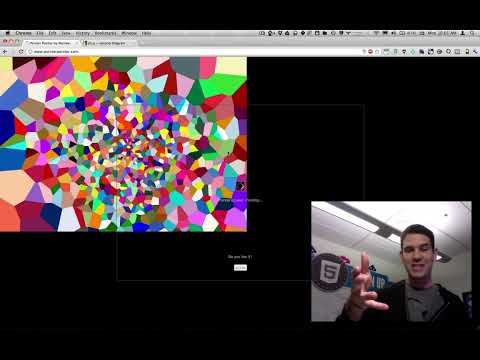 3:45
pointerpointer.com's use of voronoi, canvas, and javascript
40K views • 14 years ago
Paul Irish
Paul Irish explains how pointerpointer.com works. It uses a hidden canvas of colored Voronoi regions to look up which photo matches the cursor position.
Topic match · Computer graphics & rendering 5:26
Neural Network Learns The Physics of Fluids and Smoke | Two Minute Papers #118
209K views • 9 years ago
Two Minute Papers
Two Minute Papers covers a paper on speeding up fluid and smoke simulation with convolutional networks. It contrasts the approach with earlier regression forest methods.
Topic match · Computer graphics & rendering 21:52
英特尔Lunar Lake深度评测:轻薄本有救了!
198K views • 2 years ago
极客湾Geekerwan
Geekerwan's Chinese-language review of Intel's Lunar Lake lightweight laptop chip, covering performance, perf-per-watt curves and battery life benchmarks. It tests whether x86 can compete on efficiency.
Topic match · Computer architecture & CPUs 6:36
Intel ME explained (intel management engine) from insider
12K views • 8 years ago
jessie
A short video explaining the Intel Management Engine, a hidden embedded computer inside Intel machines with deep access to hardware. It is presented from an insider's perspective and raises backdoor and NSA concerns.
Topic match · Computer architecture & CPUs 14:03
The Computer Designed To Die In Microseconds
408K views • 3 years ago
Scott Manley
Scott Manley tells the story of a computerized telemetry system built to sit at the heart of a nuclear test device in place of the plutonium pit, designed to transmit data in the microseconds before it was destroyed.
Topic match · Computer architecture & CPUs