high-dimensional sampling
 10:33
Strange Spheres in Higher Dimensions - Numberphile
767K views • 9 years ago
Numberphile
Matt Parker on Numberphile explains the strange properties of spheres in higher dimensions, such as how they poke out of their bounding boxes. It uses Pythagoras to build intuition for 4D and beyond.
 4:30
The highway where trucks work like electric trains
5.3M views • 5 years ago
Tom Scott
Tom Scott visits an eHighway test in Lubeck, Germany, where electric trucks with pantographs draw power from overhead wires. He explains how this could electrify road freight.
 8:25
This high-speed rail project is a warning for the US
1.5M views • 4 years ago
Vox
A Vox explainer on why California's high-speed rail project is years late and far over budget, with only a few concrete structures built by 2022. It covers the political, legal and routing challenges behind the delays.
 10:51
Is olive oil safe at high heat? Does it taste bad?
1.9M views • 6 years ago
Adam Ragusea
Adam Ragusea examines whether olive oil is unsafe for high-heat cooking and whether it tastes bad when heated. He cites studies showing it is among the most stable cooking oils and that smoke-point worries are overblown.
 13:38
5040 and other Anti-Prime Numbers - Numberphile
2.4M views • 10 years ago
Numberphile
Numberphile's James Grime discusses highly composite numbers, nicknamed anti-primes, which have more factors than any smaller number, using 5040 as the central example. It touches on Plato and Ramanujan.
 6:06
The 7 Habits of Highly Miserable People
14.7M views • 9 years ago
CGP Grey
CGP Grey's sarcastic animated video adapted from the book How to Be Miserable, listing habits that reliably make people unhappy. By inverting the advice, it shows what to avoid and prompts reflection on goals and routines.
 18:18
Hilbert's Curve: Is infinite math useful?
2.4M views • 9 years ago
3Blue1Brown
3Blue1Brown explains space-filling curves and the Hilbert curve, and how infinite mathematical constructions connect to finite, practical approximations. It touches on mapping between dimensions and sensory ideas.
 12:13
Why China Is so Good at Building Railways
8.7M views • 7 years ago
Wendover Productions
A Wendover Productions explainer on how China built the world's largest high-speed rail network so quickly and why its rail strategy differs from America's. It covers politics, social benefits and the economics of unprofitable lines.
 6:26
Slow Motion Flipping Cat Physics | Smarter Every Day 58
11.3M views • 14 years ago
SmarterEveryDay
Destin of Smarter Every Day films a cat falling in high-speed slow motion to show how cats right themselves in midair, and introduces the physics behind it.
 7:53
Why Are American Health Care Costs So High?
7.7M views • 13 years ago
vlogbrothers
John Green explains why the US spends far more on health care than other countries, going through insurers, drug companies, hospitals and lawyers. He argues the causes are complicated rather than a simple blame game.
 9:40
Why American public transit is so bad | 2020 Election
6.7M views • 6 years ago
Vox
A Vox explainer from the 2020 election series on why American public transit is so poor. It traces the effect of the interstate highway system on cities and the resulting car dependence.
 15:14
The most deadly project on the Internet
6.8M views • 4 years ago
bigclivedotcom
BigClive explains why microwave oven transformer projects are extremely dangerous, since the high voltage and high current can kill. He contrasts them with spot welder builds where the secondary is replaced by low-voltage heavy wire.
 4:39
How to slow down a stock exchange
4M views • 7 years ago
Tom Scott
Tom Scott visits IEX, a stock exchange that slows down trading with a long coil of fiber. The coil removes the speed advantage of high-frequency traders.
 10:43
Bertrand's Paradox (with 3blue1brown) - Numberphile
1.4M views • 4 years ago
Numberphile
Numberphile interviews Grant Sanderson of 3blue1brown about Bertrand's paradox, where different reasonable ways of picking a random chord of a circle give different probabilities.
 6:43
The high cost of free parking
4.6M views • 9 years ago
Vox
A Vox explainer on how mandatory parking minimums and free parking impose hidden costs on cities. It draws on Donald Shoup's work and gives the history of parking requirements.
 8:25
Why Trains Suck in America
6M views • 10 years ago
Wendover Productions
Wendover Productions explains why US passenger rail lags behind other countries. It covers freight companies owning most of the track, geography and population density, and the economics of competing with flying.
 12:05
Why Traffic Congestion Grows Exponentially, Why It Matters, and What To Do About It // An Explainer
100K views • 4 years ago
Ray Delahanty | CityNerd
CityNerd explains why traffic congestion grows nonlinearly as more cars use a road network, and why adding road capacity tends not to fix it. It covers the consequences for drivers, bus riders, cyclists and pedestrians, and discusses alternatives such as true bus rapid transit.
 6:24
Wealth Inequality in America
26.7M views • 13 years ago
politizane
A short infographic video on the distribution of wealth in America, contrasting what people believe, what they consider ideal, and the actual numbers. It highlights how top-heavy US wealth is.
 13:03
Intelligence and Stupidity: The Orthogonality Thesis
710K views • 8 years ago
Robert Miles AI Safety
Robert Miles explains the orthogonality thesis: how an agent can be highly intelligent while pursuing goals that seem stupid or alien to humans. He separates intelligence from goals and touches on the stamp-collector example.
 11:11
The Agricultural Revolution: Crash Course World History #1
17.7M views • 14 years ago
CrashCourse
The first episode of Crash Course World History, in which John Green covers the shift from hunting and gathering to agriculture and how it shaped civilization. It is delivered fast and with jokes.
 17:06
What Is A Black Start Of The Power Grid?
3.1M views • 3 years ago
Practical Engineering
Practical Engineering explains what a black start is: restarting a power grid after total collapse. It shows why most plants need outside power to start and why rebuilding a synchronized grid is delicate and high-stakes.
 13:30
Cities: Skylines | Power, Politics, & Planning: Episode 1: Parking
136K views • 8 years ago
donoteat01
The first episode of a Cities: Skylines series on urban politics and planning, focused on parking. It uses the game to show how parking minimums shape cities, drawing on Donald Shoup's book The High Cost of Free Parking.
 6:18
Animated Voting Methods
16K views • 9 years ago
Unify The Vote
An animated simulation comparing single-winner voting methods such as plurality, instant runoff and STAR. Colored regions show which candidate wins as a randomized electorate shifts across a two-dimensional political space, building on Ka-Ping Yee's earlier diagrams.
 6:43
Explained: "Go Fast" UFO Video - Not Low and Not Fast - Like a Balloon!
156K views • 7 years ago
Mick West
Mick West analyzes the Navy "Go Fast" UFO footage and shows with simple trigonometry and the data overlay that the object is slow and high up, consistent with a balloon. He explains how parallax makes it look fast and argues the original TV claims were wrong.
 12:52
Why Machines That Bend Are Better
13.3M views • 7 years ago
Veritasium
Veritasium explores compliant mechanisms, devices that move by flexing rather than using hinges and joints, with researchers at BYU. It covers advantages such as fewer parts and precision, including uses in nuclear weapon safety.
 8:55
Are Space and Time An Illusion?
3.3M views • 11 years ago
PBS Space Time
A PBS Space Time episode hosted by Gabe Perez-Giz on the nature of spacetime and whether space and time are fundamental. It builds up reference frames and causality in a short, dense format.
 4:18
Flexbox vs. CSS Grid — Which is Better?
314K views • 8 years ago
Layout Land
Jen Simmons explains the difference between CSS Flexbox and CSS Grid, and when to use each. She makes the case that Grid does not replace Flexbox and most sites use both.
 4:20
Why Snow and Confetti Ruin YouTube Video Quality
10.4M views • 10 years ago
Tom Scott
Tom Scott explains why confetti and snow wreck video quality, using interframe compression and bitrate. He demonstrates it live by changing the quality on screen.
 11:10
Why Japan's Conviction Rate is 99% (Actually Explained)
82K views • 6 years ago
That Japanese Man Yuta
Yuta explains what Japan's 99% conviction rate actually means, noting that prosecutors drop cases unless confidence is very high. He argues that the number is widely misunderstood and cites his sources.
 14:24
Why Japan Arrests Foreigners
8.6M views • 7 years ago
Paolo fromTOKYO
Paolo fromTOKYO explains why foreign tourists get arrested in Japan, covering strict laws and the justice system's very high conviction rate.
 11:21
How does a whip break the sound barrier? (Slow Motion Shockwave formation) - Smarter Every Day 207
6.5M views • 7 years ago
SmarterEveryDay
Smarter Every Day uses high-speed and Schlieren photography to show how a whip crack is a supersonic shockwave formed at the tip. It references academic papers on whip physics.
 9:36
Dance p 3 Mar09
83K views • 17 years ago
Geoff Cumming
Geoff Cumming uses a simulation to show how wildly the p value varies from one replication to the next because of sampling variability. He argues for estimation and confidence intervals over null hypothesis significance testing.
 18:24
The Holographic Universe Explained
3.5M views • 7 years ago
PBS Space Time
A PBS Space Time episode explaining the holographic principle: the idea that our 3+1 dimensional universe may be described by information on a lower-dimensional boundary. It walks through black hole entropy and the AdS/CFT correspondence.
 11:39
How a TV Works in Slow Motion - The Slow Mo Guys
45.7M views • 8 years ago
The Slow Mo Guys
The Slow Mo Guys film a TV and screens with a high-speed camera to show how displays build an image. The footage includes CRT-style scanning and how pixels light up over time.
 8:14
The Lightning Network Explained (Litecoin/Bitcoin)
119K views • 9 years ago
Franklyn
An 8-minute explainer on the Lightning Network and how it relates to Segwit, Bitcoin and Litecoin. It covers how off-chain payment channels route payments to scale blockchain transactions.
 18:02
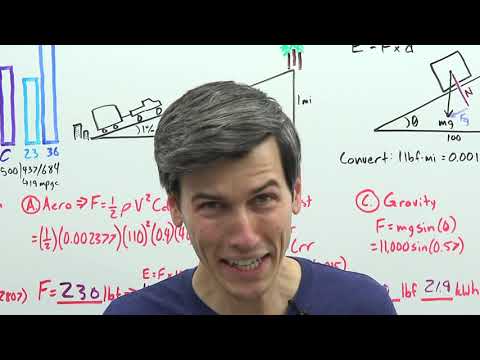
Why Teslas Are Bad At Towing (Today)
768K views • 6 years ago
Engineering Explained
Engineering Explained uses physics to show why today's electric cars, including Teslas, are poor at towing, pointing to battery energy density and weight. It examines Cybertruck and F-150 towing claims.
 13:39
China's 7nm Chips: SMIC N+2
492K views • 4 years ago
Asianometry
Asianometry's short analysis of SMIC's N+2 node, China's 7nm leap forward. It considers how far behind the competition SMIC still is.
 5:17
The IGF-1 Trade-Off: Performance vs. Longevity
517K views • 13 years ago
FoundMyFitness
A short FoundMyFitness explainer on the trade-off between growth hormone/IGF-1 and longevity. Higher IGF-1 helps muscle and cognition, while lower levels are linked to longer lifespan and stress resistance.
 5:06
Ion drive: The first flight
2.4M views • 7 years ago
nature video
Nature video showing MIT researchers flying the first plane with no moving parts, powered by an ion drive that creates an ionic wind from high-powered electrodes. The 5m-wide craft flies across a sports hall.