hot reloading
 20:34
How big is a visible photon?
793K views • 5 years ago
Huygens Optics
Huygens Optics shows through a laser interference experiment that the question of a photon's size is really about coherence length. It argues that photons exist as energy exchanges between radiation and matter, not as little particles in free space.
 11:33
Light Waves Visualized using Photon Sieves.
69K views • 6 years ago
Huygens Optics
Huygens Optics shows how DIY photon sieves shape a laser's wave front, explaining how they differ from zone plates and how aperture count affects the focal point, with time-resolved visualizations of the diffraction.
 4:31
Why Photos of the Eiffel Tower at Night are Illegal
12.1M views • 9 years ago
Half as Interesting
Half as Interesting explains why the Eiffel Tower's night-time lighting is under copyright, which makes publishing photos of it at night legally problematic.
 6:07
How An Infinite Hotel Ran Out Of Room
38.5M views • 5 years ago
Veritasium
Veritasium shows how Hilbert's infinite hotel can still run out of room, using infinite buses of guests. It explains the surprising answer in a short animated segment.
 38:31
The $200M Machine that Prints Microchips: The EUV Photolithography System
2.4M views • 1 year ago
Branch Education
Branch Education's animated deep dive into ASML's EUV photolithography machine and how it prints nanometer-scale transistors onto chips. It covers the system's components and the process of chip manufacturing.
 12:24
The 1988 VIDEO Floppy Disk Camera: Canon Xap Shot RC-250
452K views • 8 years ago
LGR
LGR looks at the 1988 Canon Xap Shot, a still video camera that records photos to a floppy disk as analog NTSC signal rather than digital data.
 4:10
Where Do Trees Get Their Mass?
2.5M views • 14 years ago
Veritasium
Veritasium asks people where a tree's mass comes from, then explains that most of a dry tree's mass originates from carbon dioxide in the air. It combines street interviews with a short explanation of photosynthesis.
 2:58
Why Britain Uses Separate Hot and Cold Taps
6.8M views • 12 years ago
Tom Scott
Tom Scott explains why Britain historically has separate hot and cold taps rather than mixer taps, tracing it to how water was stored in tanks. He notes why the hot tap is not safe to drink from.
 7:38
Does Hot Water Freeze Faster Than Cold Water?
5M views • 9 years ago
Sciencium
Sciencium examines the Mpemba effect, the claim that hot water freezes faster than cold water. It walks through experiments and a published paper questioning the effect.
 21:24
The Shotgun Booby Trap (The Case Of)
1.9M views • 6 years ago
LegalEagle
LegalEagle analyzes Katko v. Briney, the Iowa case about a homeowner whose shotgun booby trap injured a burglar, and the limits on deadly force in defending property.
 22:54
Did People Used To Look Older?
21M views • 4 years ago
Vsauce
Vsauce explores whether people in past decades really looked older than people of the same age today, or whether photographic and cultural factors make them seem so. It draws on old photos, yearbooks and perception research.
 4:07
Why do competitors open their stores next to one another? - Jac de Haan
7.4M views • 14 years ago
TED-Ed
A short animated TED-Ed lesson in which two competing ice cream vendors on a beach illustrate why rival shops cluster together. It introduces game theory and the Nash equilibrium through the Hotelling model.
 11:21
How does a whip break the sound barrier? (Slow Motion Shockwave formation) - Smarter Every Day 207
6.5M views • 7 years ago
SmarterEveryDay
Smarter Every Day uses high-speed and Schlieren photography to show how a whip crack is a supersonic shockwave formed at the tip. It references academic papers on whip physics.
 5:01
How a Laser-Shot Disk Defeats Hackers & Pirates (Coding Secrets)
132K views • 8 years ago
GameHut
An episode of Coding Secrets by Jon Burton on retro copy protection, in particular physically damaging a disk with a laser so copies fail. It explains how this defeated hackers and pirates.
 4:17
AI Learns Noise Filtering For Photorealistic Videos | Two Minute Papers #215
65K views • 8 years ago
Two Minute Papers
A Two Minute Papers episode on NVIDIA's recurrent denoising autoencoder, which cleans up noisy Monte Carlo path-traced image sequences. It shows how a neural network can produce usable renders from very few samples.
 8:09
Google Earth’s Incredible 3D Imagery, Explained
3.1M views • 9 years ago
Nat and Friends
A short explainer from Nat and Friends on where Google Earth's 3D imagery comes from, how it is stitched together, and how often it is updated. It describes aircraft carrying camera rigs and photogrammetry that turns the photos into 3D models.
 12:23
Typesetters in the '80s - Computerphile
105K views • 12 years ago
Computerphile
Professor Brailsford of the University of Nottingham describes how the university set out to print its own mathematics exam papers in the 1980s. The story centers on getting a Mergenthaler Linotron 202 typesetter to work with their own software.
 11:13
What if you could only see the world in UV?
5.6M views • 8 years ago
Veritasium
Veritasium shows what the world looks like through a UV camera. It covers how pigments absorb UV, how fluorescence works, and how UV imaging reveals sunscreen effectiveness and skin damage.
 9:04
Jackie Chan - How to Do Action Comedy
25.4M views • 11 years ago
Every Frame a Painting
Every Frame a Painting analyzes how Jackie Chan stages action comedy, with nine principles such as starting from a disadvantage, using the environment, clear shots, and keeping action and reaction in the same frame.
 7:16
Unix and Google
9K views • 10 years ago
FOAM
A short animated simulation comparing how Multics and Unix were developed, showing why Unix's small composable programs and pipes gave it a efficiency advantage. It frames Unix as a moonshot achievable by a small team.
 20:13
The Most Powerful Computers You've Never Heard Of
13.7M views • 4 years ago
Veritasium
Veritasium traces analog computers from the Antikythera mechanism and Kelvin's tide-predicting machines to fire control and modern analog approaches. It explains how these machines computed continuously rather than digitally.
 21:25
Gimbal UFO - A New Analysis
208K views • 4 years ago
Mick West
Mick West analyzes the Navy's Gimbal UFO video and gives four checkable observations suggesting it is an infrared glare that appears to rotate because the camera rotates while tracking. He argues the object is likely a hot craft hidden behind the glare.
 7:07
Feynman: What things really are like FUN TO IMAGINE 1
747K views • 17 years ago
Christopher Sykes
A clip from the 1983 BBC series Fun to Imagine in which Richard Feynman explains heat as the jiggling of atoms and how we perceive it as hot and cold.
 9:06
Vancouver Never Plays Itself
2.2M views • 11 years ago
Every Frame a Painting
A video essay from Every Frame a Painting about Vancouver, a major film production city that almost never appears onscreen as itself. It shows clips of films and TV shot there that pass the city off as somewhere else.
 13:39
How is this Website so fast!?
2.4M views • 2 years ago
Wes Bos
Wes Bos breaks down the techniques behind the McMaster-Carr website's speed: server-rendered HTML, prefetching, CDN and service worker caching, preloading, critical CSS and fixed-size images. He also notes its old-school jQuery and YUI JavaScript.
 18:20
The Problem with Solar Energy in Africa
8.1M views • 5 years ago
Real Engineering
Real Engineering looks at why Africa's abundant solar potential is hard to turn into usable power, especially for Europe. It covers the transmission, infrastructure and economic obstacles, and the pivot from concentrated solar to photovoltaics.
 18:10
A London Accent from the 14th to the 21st Centuries
7.2M views • 5 years ago
Simon Roper
Linguist Simon Roper reconstructs how a London accent would have sounded from the 14th to the 21st centuries, reading passages in period pronunciation. It draws on the Cambridge History of the English Language.
 5:33
Adam Ruins Everything - The Truth About the McDonald's Coffee Lawsuit
978K views • 9 years ago
truTV
An Adam Ruins Everything segment on the real facts of the McDonald's hot coffee lawsuit, covering the severity of the burns and the corporate PR campaign that painted it as frivolous.
 17:40
3D Gaussian Splatting! - Computerphile
273K views • 2 years ago
Computerphile
A Computerphile video in which Dr Mike Pound and PhD student Lewis Stuart explain 3D Gaussian splatting, a quick technique that turns photos of a scene into a 3D model without much compute. It includes a demo and compares the approach to NeRFs.
 39:34
The Ridiculous Engineering Of Jet Engines
16.8M views • 11 months ago
Veritasium
Veritasium explains how jet engines run hotter than their components' melting points, using cooling air and single-crystal superalloy turbine blades. It covers how the blades are grown as aligned crystals.
 2:27
What is a rocket mass heater?
508K views • 9 years ago
paul wheaton
A two-minute explanation of what a rocket mass heater is, starting from how a conventional wood stove works and why creosote and chimney fires occur. It shows how burning hot and storing the heat in thermal mass makes for an efficient heater.
 22:22
Some light quantum mechanics (with minutephysics)
2.2M views • 9 years ago
3Blue1Brown
3Blue1Brown, in collaboration with minutephysics, introduces the math of superposition and quantum states using polarized light. It builds up the quantum behavior of photons as a simple counting and probability problem.
 3:45
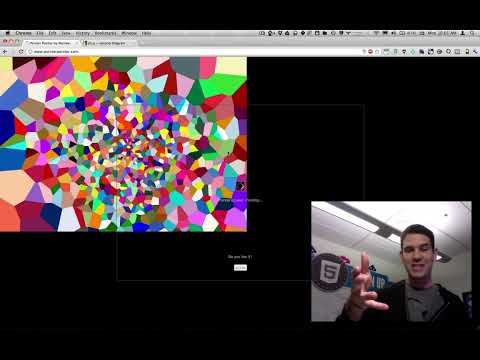
pointerpointer.com's use of voronoi, canvas, and javascript
40K views • 14 years ago
Paul Irish
Paul Irish explains how pointerpointer.com works. It uses a hidden canvas of colored Voronoi regions to look up which photo matches the cursor position.