image processing
 8:09
Google Earth’s Incredible 3D Imagery, Explained
3.1M views • 9 years ago
Nat and Friends
A short explainer from Nat and Friends on where Google Earth's 3D imagery comes from, how it is stitched together, and how often it is updated. It describes aircraft carrying camera rigs and photogrammetry that turns the photos into 3D models.
 11:47
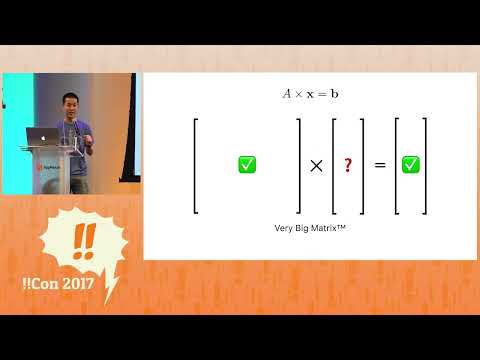
!!Con 2017: HDR Photography in Microsoft Excel?! by Kevin Chen
119K views • 9 years ago
Confreaks
A short conference talk from !!Con 2017 in which Kevin Chen explains the HDR imaging algorithm from a foundational paper, framing it as a system of linear equations, and implements it in a Microsoft Excel spreadsheet. No prior image processing knowledge is needed.
Topic match · Computer vision, speech & NLP 1:16
Enemy of the state - Freeze,Rotate,Zoom,Focus,Enhance!
221K views • 15 years ago
Movietwist
A one-minute scene from the film Enemy of the State showing absurdly implausible image enhancement, with freezing, rotating, zooming and focusing on a video.
Topic match · Computer vision, speech & NLP 37:20
But how do AI images and videos actually work? | Guest video by Welch Labs
2.2M views • 1 year ago
3Blue1Brown
A guest video by Welch Labs on 3Blue1Brown explaining how text-to-image and video models work. It covers CLIP, shared embedding spaces, diffusion models (DDPM, DDIM), conditioning, guidance and negative prompts.
 1:18
Why I Don't Watch CSI
1.7M views • 17 years ago
tempura1234
A one-minute clip from a CSI episode featuring the trope of zooming and enhancing low-resolution images. The uploader says it was the last CSI episode they watched.
Topic match · Computer vision, speech & NLP 1:44
Let's Enhance HD
879K views • 13 years ago
Duncan Robson
A two-minute supercut of film and TV characters ordering a computer to 'enhance' a blurry image into a perfectly sharp one. It is a remaster of an earlier 2009 version.
Topic match · Computer vision, speech & NLP 1:44
Let's Enhance
3.8M views • 16 years ago
Duncan Robson
A two-minute compilation of TV and film scenes where investigators say 'enhance' and a blurry image becomes sharp. It mocks the trope.
Topic match · Computer vision, speech & NLP 25:52
Halide Talk
53K views • 12 years ago
Andrew Adams
Andrew Adams, a Halide developer, presents the Halide language for image processing and tensor computation. The talk explains the separation of algorithm from schedule with illustrated examples of parallelism, locality and redundancy tradeoffs.
 11:01
Pulling Clear Images Directly Off Satellites | GOES-15,16,17 and Himawari 8 HRIT
635K views • 8 years ago
The Thought Emporium
The Thought Emporium shows how to receive clear images directly from GOES-15, 16 and 17 and Himawari 8 geostationary weather satellites with software-defined radio. It covers the extra effort needed to receive GOES data.
 51:33
Human Computation
31K views • 14 years ago
GoogleTalksArchive
A 2006 Google TechTalk in which Luis von Ahn introduces human computation, using people's effort to solve problems like image recognition that computers cannot yet handle. It covers games with a purpose and related ideas such as CAPTCHAs.
Topic match · Computer vision, speech & NLP 1:04
Silicon Valley: Not Hotdog (Season 4 Episode 4 Clip) | HBO
516K views • 9 years ago
HBO
An HBO clip from Silicon Valley season 4 in which the 'Not Hotdog' app is demoed. The app classifies food photos as hot dog or not hot dog.
Topic match · Computer vision, speech & NLP 2:41
Blade Runner Enhance Scene
315K views • 15 years ago
Colton Casados-Medve
The Blade Runner scene in which Deckard uses a voice-controlled machine to enhance a photograph, zooming into hidden details.
Topic match · Computer vision, speech & NLP 4:14
Computer Color is Broken
4.3M views • 11 years ago
minutephysics
MinutePhysics explains that computers store brightness nonlinearly, so blurring and blending colors in raw RGB gives wrong, dark results. It shows why mixed colors, such as in gradients, look off.
 1:06:26
Over the Shoulder 1 - Text Preprocessing in Forth
25K views • 12 years ago
Andreas Wagner
Samuel Falvo II live-codes a text preprocessor and blog engine in Forth over about an hour. It shows Forth's dictionary being snapshotted and restored in place of mutation, and how a small Forth system gets real work done.
 15:12
JPEG DCT, Discrete Cosine Transform (JPEG Pt2)- Computerphile
697K views • 11 years ago
Computerphile
Mike Pound explains the discrete cosine transform and how it underpins JPEG compression. It is part two of Computerphile's JPEG series.
Topic match · Computer vision, speech & NLP 4:32
The Visual Microphone: Passive Recovery of Sound from Video
1.9M views • 12 years ago
Abe Davis's Research
MIT researchers show that sound can be recovered from silent video by analyzing tiny vibrations in objects such as a potato chip bag. It works even with consumer cameras by using rolling shutter.
Topic match · Computer vision, speech & NLP 1:15:21
Marc Levoy - Lectures on Digital Photography - Lecture 1 (21mar16).mp4
512K views • 10 years ago
Marc Levoy
The first lecture in an 18-part series on digital photography from Marc Levoy's Stanford CS 178 course, recorded at Google in 2016. The series covers how digital cameras work and computational photography, with slides and assignments available on the course site.
 30:53
I Saved a PNG Image To A Bird
2.1M views • 1 year ago
Benn Jordan
Benn Jordan's video about storing a PNG image in a living bird, a starling that learns to reproduce encoded sounds. It mixes ornithology, audio engineering, and data encoding.
 27:16
How Do Night Vision Goggles Work?
8.4M views • 3 years ago
Veritasium
Veritasium visits the US Navy's Crane facility to test top night vision goggles. It explains how image intensifier tubes and thermal or digital systems work and compares the generations of the technology.
 5:52
[Equation] - Aphex Twin Spectrogram
476K views • 17 years ago
HappyQuark
A spectrogram analysis of Aphex Twin's track commonly called [Equation] from Windowlicker, rendered from a lossless version. At about 5:30 the spectrogram reveals an image of Richard D. James's face.
 0:06
Do I look like I know what a JPEG is?
8.5M views • 13 years ago
BobRobster
A King of the Hill clip in which Hank-style character rants about saving images as PNG instead of JPEG after exporting from Windows Paint.
 5:10
Dual Photography
24K views • 17 years ago
mm648230
The SIGGRAPH 2005 demo of dual photography from Stanford, which swaps the roles of projector and camera to render a scene from the light's point of view. It includes the reveal of a hidden playing card.
Topic match · Computer vision, speech & NLP 7:53
How the US Postal Service reads terrible handwriting
7M views • 4 years ago
Tom Scott
Tom Scott visits the USPS Remote Encoding Center in Salt Lake City, where keyers decipher mail images machines cannot read. It shows the lengths taken to decode bad handwriting.
Topic match · Computer vision, speech & NLP 1:00
BFS-Auto: High Speed Book Scanner at over 250 pages/min
1.3M views • 13 years ago
Ishikawa Group Laboratory
A University of Tokyo lab demonstrates a book scanner that flips pages automatically and scans over 250 pages per minute. It uses real-time 3D recognition of the flipped pages and then restores each one to a flat image.
Topic match · Computer vision, speech & NLP 1:37:45
Alan Kay: Doing with Images Makes Symbols (Full Version)
44K views • 11 years ago
Kenneth Friedman
A full upload of Alan Kay's 1987 talk, with demos of several Smalltalk-era software systems and ideas about visual, kinesthetic and symbolic reasoning. It includes a Smalltalk program written by a 12-year-old and footage of the Rand tablet.
 12:31
The Superheterodyne Radio: No really, that's its name
987K views • 7 years ago
Technology Connections
Technology Connections explains why the superheterodyne radio has its name and how mixing frequencies lets it tune stations well. It walks through the underlying wave phenomena and algebra and why the design solved a hard tuning problem.
 46:27
Sensor Fusion on Android Devices: A Revolution in Motion Processing
517K views • 16 years ago
Google TechTalks
David Sachs of InvenSense explains how gyroscopes, accelerometers and compasses work on their own and together, demonstrated on a modified Android handset. He covers sensor fusion algorithms and why rotation math such as Euler angles matters.
 12:54
I have APHANTASIA (and you may too...without realising it!)
8M views • 8 years ago
JAMIEvstheVOID
An artist describes discovering she has aphantasia, the inability to form mental images, and how it affects her work. She asks viewers about their own visualization.
 17:01
Your Brain Hallucinates Your Conscious Reality | Anil Seth | TED
12M views • 9 years ago
TED
Neuroscientist Anil Seth argues in this TED talk that perception is a controlled hallucination: the brain constantly predicts the world and our shared agreement is what we call reality. He also touches on the construction of the self.
 31:06
Jim Keller - Moore's Law in the age of AI Chips
33K views • 6 years ago
Matroid
Jim Keller's talk at the 2020 Scaled Machine Learning conference on Moore's Law in the age of AI chips. He compares scalar, vector and GPU-style parallel approaches to computation.
 18:18
I Tried Turning Games Into Text
571K views • 2 years ago
Acerola
Acerola explores building a shader that turns games into ASCII art, walking through techniques such as brightness mapping and edge detection to see whether it looks good.
 1:14
Today Show Canoe
1.3M views • 15 years ago
profwaggstaff
An NBC Today Show correspondent appears to row a canoe in deep storm floodwater, though the water is only about six inches deep. The uploader notes it is a misleading depiction rather than intentional fake news.
 41:18
"Voice Driven Development: Who needs a keyboard anyway?" by Emily Shea
35K views • 7 years ago
Strange Loop Conference
Emily Shea explains how repetitive strain injury pushed her to program by voice using speech recognition (Talon), and gives a live coding demo. She argues voice-driven development can be pain-free, efficient and enjoyable.
Topic match · Computer vision, speech & NLP 18:31
Fourier Optics used for Optical Pattern Recognition
103K views • 6 years ago
Huygens Optics
Huygens Optics explains the Fourier transform and shows how a lens performs one optically. A DLP projector is used as a Fourier filter to do simple pattern recognition on lithographic character patterns.
Topic match · Computer vision, speech & NLP 2:13:35
Let's build the GPT Tokenizer
1.3M views • 2 years ago
Andrej Karpathy
Andrej Karpathy builds the GPT tokenizer from scratch, implementing byte pair encoding along with encode and decode. He shows how many odd LLM behaviors trace back to tokenization, and covers Unicode byte encodings along the way.
Topic match · Computer vision, speech & NLP 16:40
Massive-scale online collaboration | Luis von Ahn
315K views • 14 years ago
TED
Luis von Ahn, creator of CAPTCHA and reCAPTCHA, explains how small contributions from many people online can digitize books. He then introduces Duolingo as a way to translate the web while people learn languages.
Topic match · Computer vision, speech & NLP 53:46
Dasher: information-efficient text entry
7K views • 19 years ago
Google TechTalks
David MacKay's 2007 Google Tech Talk presents Dasher, a text-entry system driven by continuous gestures and a language model, reaching about 35 words per minute with one finger and 25 hands-free. It explains the information-theory reasoning behind the design.
Topic match · Computer vision, speech & NLP 28:48
LSTM is dead. Long Live Transformers!
540K views • 6 years ago
Seattle Applied Deep Learning
Leo Dirac explains how transformer models have replaced LSTMs in NLP. He gives background from bag of words through RNNs and LSTMs, then a technical deep dive into multi-headed self-attention and positional encoding, with sample code.
Topic match · Computer vision, speech & NLP 13:30
Stealing Baseball Signs with a Phone (Machine Learning)
30M views • 7 years ago
Mark Rober
Mark Rober and Jabril build an app that uses machine learning to decode baseball sign sequences. The video also explains neural networks in a simple, accessible way.
Topic match · Computer vision, speech & NLP 52:52
Google Developers Day US - Theorizing from Data
27K views • 19 years ago
GoogleDeveloperDay
Peter Norvig's 2007 Google talk on theorizing from data, covering what huge datasets can do for language understanding, translation, information extraction and inference. It argues that more data often beats cleverer models.
Topic match · Computer vision, speech & NLP