signed distance functions
 51:06
NVScene 2015 Session: How to Create Content with Signed Distance Functions (Johann Korndörfer)
35K views • 11 years ago
NVScene
Johann Korndorfer's NVScene 2015 talk on building content with signed distance functions. It focuses on patterns that make SDF modelling more structured, arguing that SDFs capture a shape's essence like vector graphics do compared with polygons or voxels.
 28:33
Terence Tao on the cosmic distance ladder
6.5M views • 1 year ago
3Blue1Brown
Terence Tao and Grant Sanderson of 3Blue1Brown walk through the cosmic distance ladder, showing how humans measured distances from the Earth to the Moon, Sun, planets and beyond. It includes animations and the history behind each step.
 24:46
Painting a Character with Maths
458K views • 5 years ago
Inigo Quilez
Inigo Quilez live-codes a cartoon character painting entirely from math, using signed distance fields in a Shadertoy shader. He explains each step of building the image from formulas.
 30:46
Alex Evans at Umbra Ignite 2015: Learning From Failure
68K views • 11 years ago
Media Molecule
Media Molecule's Alex Evans recounts the journey, including the failures, of finding the Dreams engine, based on his Siggraph 2015 talk. It covers the signed-distance-field and splat-based rendering approach and the artistic goals behind it.
 24:02
Learn to Paint with Mathematics
191K views • 12 years ago
Inigo Quilez
Inigo Quilez live-codes a painting using only mathematics in a shader, building it up step by step. The linked Shadertoy source shows the result.
 1:16:17
Terence Tao: The Cosmic Distance Ladder, UCLA
203K views • 16 years ago
UCLA
Terence Tao's AMS Einstein Public Lecture at UCLA on the cosmic distance ladder, the chain of methods astronomers use to measure distances from the Earth to distant galaxies. It is aimed at a general audience.
 9:16
Quantum Entanglement & Spooky Action at a Distance
4.5M views • 11 years ago
Veritasium
Veritasium explains quantum entanglement and spooky action at a distance, walking through Bell's inequality and the experiments that rule out hidden variables, in under ten minutes.
 19:40
How I Designed a Free Music Font for 5 Million Musicians (MuseScore 3.6)
608K views • 5 years ago
Tantacrul
Tantacrul explains how he and engraver Simon Smith designed the free music notation font for MuseScore 3.6. It draws on the history of the SCORE notation application by Leland Smith.
 10:22
How Far Are The Nearest Stars?
3.7M views • 9 years ago
Cody'sLab
Cody's Lab builds a 200-billionth-scale model to show how far away the nearest stars are, using parallax and light speed. A short astronomy explainer on interstellar distances.
 5:43:06
LIVE Coding "Happy Jumping"
106K views • 7 years ago
Inigo Quilez
Inigo Quilez live-codes the "Happy Jumping" animated scene in a Shadertoy GLSL shader over about six hours. He builds the raymarched character step by step, explaining the math and procedural techniques, with checkpoints linked for each stage.
 39:34
Control Malfunctions & Flight Instrument Anomalies, by Captain Warren VanderBurgh.
153K views • 12 years ago
flightcrewguide.com
An American Airlines training video by Captain Warren VanderBurgh on control malfunctions and flight instrument anomalies. It discusses real incidents such as runaway trim and instrument failures and how crews should respond.
 25:05
The Best-Designed Town in the Netherlands (and therefore, the world)
1.2M views • 1 year ago
Not Just Bikes
Not Just Bikes tours Houten, a Dutch town designed around cycling, explaining how its layout makes most trips by bike safe and easy. It also promotes a book about the town.
 14:03
The Computer Designed To Die In Microseconds
408K views • 3 years ago
Scott Manley
Scott Manley tells the story of a computerized telemetry system built to sit at the heart of a nuclear test device in place of the plutonium pit, designed to transmit data in the microseconds before it was destroyed.
 54:14
Zig: A programming language designed for robustness, optimality, and clarity – Andrew Kelley
75K views • 8 years ago
Recurse Center
Andrew Kelley, creator of Zig, introduces the language at the Recurse Center's Localhost series in 2018. He covers its goals of robustness, optimality and clarity, C interop, cross-compilation and explicit allocators.
 11:32
Depth-first search in APL
11K views • 12 years ago
Dyalog
John Scholes builds a depth-first tree-search operator step by step in a Dyalog APL session. It covers higher-order functions and runs the search on the N-Queens problem.
 16:38
Games, Schools, and Worlds Designed for Violence
3.1M views • 7 years ago
Jacob Geller
Jacob Geller's video essay examines how architecture in schools and in video games, such as cover shooters, is shaped by violence. It touches on brutalism, campus policing and protests.
 18:19
Why city flags may be the worst-designed thing you've never noticed | Roman Mars
5.2M views • 11 years ago
TED
Roman Mars gives a funny TED talk on vexillology, laying out five basic principles of good flag design and why many city flags fail them.
 5:24
Diffie-Hellman Key Exchange
547K views • 14 years ago
Art of the Problem
A short Art of the Problem clip explaining Diffie-Hellman key exchange, using a paint mixing analogy for one-way functions and touching on modular arithmetic and discrete logarithms.
 10:14
Making a heart with Maths
112K views • 9 years ago
Inigo Quilez
Inigo Quilez shows step by step how to build a simple heart shape from mathematics and shaders, with code on Shadertoy. It is an introduction to procedural graphics and signed distance functions.
 6:09
These tunnels are designed for 100,000 years
4.3M views • 7 years ago
Tom Scott
Tom Scott visits Onkalo in Finland, the planned deep geologic repository for high-level nuclear waste intended to be sealed for 100,000 years.
 55:06
Modern SQL: A lot has changed since SQL-92 by Markus Winand
6K views • 8 years ago
Devoxx
Markus Winand shows how SQL has evolved since SQL-92, comparing old-style solutions to modern features such as window functions and system versioning, and notes that many developers never learn them.
 16:36
JWST just made the "Crisis in Cosmology" WORSE
1.3M views • 3 years ago
Dr. Becky
Astrophysicist Dr. Becky explains the Hubble tension, the disagreement between expansion-rate measurements from the cosmic microwave background and the distance ladder, and what early JWST Cepheid observations add.
 8:25
Calculating a Car Crash - Numberphile
446K views • 8 years ago
Numberphile
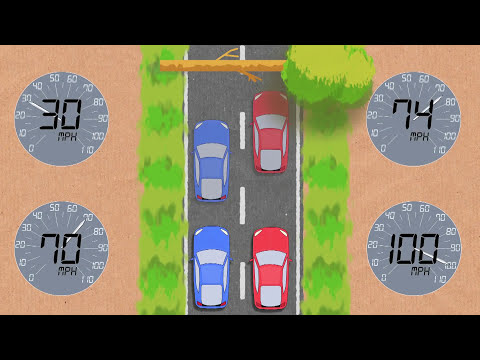
Numberphile's Ben Sparks works through the physics of a car crash, showing how kinetic energy grows with the square of speed and why stopping distance climbs so quickly as velocity increases.
 15:15
why Japan's internet is weirdly designed
5.2M views • 3 years ago
Answer in Progress
Answer in Progress investigates why Japanese websites look different from those elsewhere, using an AI clustering approach to test the 2013 claim. It then looks at possible explanations.
 18:05
Intro to AI Safety, Remastered
210K views • 5 years ago
Robert Miles AI Safety
Robert Miles gives a remastered introduction to AI safety, adapted from a talk in London. It lays out why advanced AI could go wrong and answers common objections.
 57:39
CppCon 2016: Chandler Carruth “Garbage In, Garbage Out: Arguing about Undefined Behavior..."
94K views • 10 years ago
CppCon
Chandler Carruth's CppCon 2016 talk tries to defuse the heated debate over undefined behavior in C and C++. He explains from the compiler writer's perspective why UB exists and how it enables optimization.
 22:59
How Does SHA-256 Work?
374K views • 6 years ago
learnmeabitcoin
A step-by-step animated explanation of how SHA-256 works, from padding and message schedule to the compression function and final hash, with source code for the animations.
 50:56
DEFCON 20: Hacker + Airplanes = No Good Can Come Of This
226K views • 13 years ago
Christiaan008
A DEF CON 20 talk by RenderMan on the security weaknesses of ADS-B, the unencrypted, unauthenticated aircraft tracking broadcast. It shows how easily the data can be spoofed and what that means for security designed in too late.
 21:59
The Most Unwanted Song (FULL VERSION)
2.1M views • 14 years ago
FraKctured
The 1997 novelty song by Komar and Melamid with composer Dave Soldier, built from survey results on what listeners dislike most in music. It features bagpipes, an opera singer rapping, and a children's choir urging shopping at Wal-Mart.
 1:25:27
Neuroscience of Personality | Dario Nardi | Talks at Google
163K views • 15 years ago
Talks at Google
UCLA professor Dario Nardi presents brain-imaging research suggesting that different Myers-Briggs personality types use their brains in different ways. He discusses how each type can reach a state of creative flow. It is aimed at a general audience.
 55:02
GradIEEEnt half decent: The hidden power of imprecise lines
391K views • 3 years ago
suckerpinch
Tom 7 (suckerpinch) delivers a long, comedic digression on gradient descent and floating-point imprecision. He shows how rounding behavior can supply the nonlinearity needed to build a neural network.
 24:31
Explosive Bat: crushing MLB records. Ft: Smarter Every Day
18.7M views • 6 years ago
Stuff Made Here
Stuff Made Here builds a powder-actuated baseball bat designed to hit a ball past Babe Ruth's record distance, with Smarter Every Day contributing. It covers the engineering of the explosive-assisted swing.
 19:09
A Better Default Colormap for Matplotlib | SciPy 2015 | Nathaniel Smith and Stéfan van der Walt
177K views • 11 years ago
Enthought
SciPy 2015 talk by Nathaniel Smith and Stefan van der Walt on choosing a new default colormap for Matplotlib. It covers why Jet misleads, how perceptual color spaces work, and how viridis was designed.
 1:12:27
CppCon 2015: Andrei Alexandrescu “std::allocator...”
196K views • 11 years ago
CppCon
Andrei Alexandrescu's CppCon 2015 talk argues that std::allocator is badly designed. He proposes building high-performance allocators from small composable, templated pieces.
 51:18
Lexical Scanning in Go - Rob Pike
162K views • 15 years ago
GoogleFOSSSydney
Rob Pike shows how the Go text/template lexer is built, using state functions, goroutines and channels. The talk was given at a Google Technology User Group in Sydney in 2011.
 51:32
Behind the Scenes of iOS Security
127K views • 10 years ago
Black Hat
Apple security head Ivan Krstic gives a Black Hat 2016 talk on iOS security, covering HomeKit, Auto Unlock and iCloud Keychain. He explains key hierarchies and how data can stay safe even in adversarial clouds.
 59:34
CppCon 2017: Matt Kulukundis “Designing a Fast, Efficient, Cache-friendly Hash Table, Step by Step”
137K views • 9 years ago
CppCon
Matt Kulukundis explains how Google designed SwissTable, a fast, cache-friendly hash table, step by step from std::unordered_map. The talk covers open addressing, SIMD probing and the tradeoffs of changing a fundamental data structure.
 1:14:52
Effective Programs - 10 Years of Clojure - Rich Hickey
176K views • 9 years ago
ClojureTV
Rich Hickey's talk at Clojure's tenth anniversary on the kind of programs Clojure is designed for. He argues for situated programs that deal with changing requirements, and for dynamic typing and data over static types.
 23:32
The Solar Gravitational Lens will Map Exoplanets. Seriously.
582K views • 6 years ago
Launch Pad Astronomy
Explains the proposed NASA JPL plan to use the Sun as a gravitational lens, sending solar sail craft to its focal region to image an exoplanet's surface. It covers the distances involved, how imaging with the Sun would work and the mission design.
 1:10:15
Tech Talk: Linus Torvalds on git
4.1M views • 19 years ago
Google
Linus Torvalds gives a Google tech talk on git, the source control system he created two years earlier. He argues for distributed version control over centralized systems such as CVS and Subversion.