vector processing
 19:12
Taking Vector Transposes Seriously | Jiahao Chen | JuliaCon 2017
7K views • 9 years ago
The Julia Programming Language
Jiahao Chen's JuliaCon 2017 talk argues that vector transposes should be taken seriously in type systems and linear algebra libraries. It explains why treating vectors as matrices causes trouble in languages.
 51:16
Why can't you multiply vectors?
524K views • 3 years ago
Freya Holmér
Freya Holmer's Dutch Game Day 2023 talk asking why vectors can't be multiplied, building from complex numbers to a single axiom and arriving at geometric algebra, quaternions and multivectors.
 31:06
Jim Keller - Moore's Law in the age of AI Chips
33K views • 6 years ago
Matroid
Jim Keller's talk at the 2020 Scaled Machine Learning conference on Moore's Law in the age of AI chips. He compares scalar, vector and GPU-style parallel approaches to computation.
 25:52
Halide Talk
53K views • 12 years ago
Andrew Adams
Andrew Adams, a Halide developer, presents the Halide language for image processing and tensor computation. The talk explains the separation of algorithm from schedule with illustrated examples of parallelism, locality and redundancy tradeoffs.
 1:02:09
Seymour Cray's Only Surviving Talk: "Cray-1 Introduction" (1976, LANL)
59K views • 16 years ago
UC Berkeley Events
Seymour Cray's only surviving recorded talk, introducing the Cray-1 supercomputer in 1976. He describes the machine's design, including its vector architecture and cooling through the frame.
 11:47
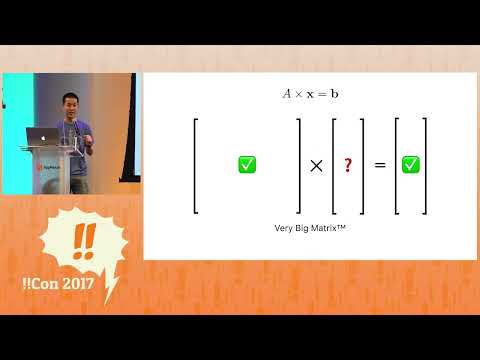
!!Con 2017: HDR Photography in Microsoft Excel?! by Kevin Chen
119K views • 9 years ago
Confreaks
A short conference talk from !!Con 2017 in which Kevin Chen explains the HDR imaging algorithm from a foundational paper, framing it as a system of linear equations, and implements it in a Microsoft Excel spreadsheet. No prior image processing knowledge is needed.
 46:27
Sensor Fusion on Android Devices: A Revolution in Motion Processing
517K views • 16 years ago
Google TechTalks
David Sachs of InvenSense explains how gyroscopes, accelerometers and compasses work on their own and together, demonstrated on a modified Android handset. He covers sensor fusion algorithms and why rotation math such as Euler angles matters.
 17:01
Your Brain Hallucinates Your Conscious Reality | Anil Seth | TED
12M views • 9 years ago
TED
Neuroscientist Anil Seth argues in this TED talk that perception is a controlled hallucination: the brain constantly predicts the world and our shared agreement is what we call reality. He also touches on the construction of the self.
 23:32
Industrial Strength High Performance RISC V Processors For Energy Efficient Computing
8K views • 8 years ago
RISC-V International
David Ditzel of Esperanto Technologies presents their massively parallel, energy-efficient RISC-V processors at the 7th RISC-V Workshop in 2017. It covers the high-performance many-core design aimed at machine learning.
 47:43
"Turning the database inside out with Apache Samza" by Martin Kleppmann
205K views • 12 years ago
Strange Loop Conference
Martin Kleppmann argues that databases are global shared mutable state and proposes treating them as an ever-growing log of immutable facts. Derived data such as caches, indexes and views is then built by stream processors like Apache Samza. The talk draws on Kafka and LinkedIn's experience with commit logs.
 1:26:11
Succinct Data Structures
9K views • 12 years ago
Edward Kmett
Edward Kmett's 2013 talk at Prezi in Budapest on succinct data structures, which store data in close to the information-theoretic minimum space while supporting fast queries. It ties together the research and walks through his Haskell succinct library.
 52:07
What Bodies Think About: Bioelectric Computation Outside the Nervous System - NeurIPS 2018
103K views • 7 years ago
The Artificial Intelligence Channel
Michael Levin's NeurIPS 2018 talk on bioelectric computation outside the nervous system, showing how cell electrical networks shape development and regeneration. It covers morphological information processing in living tissue.
 59:56
AWS re:Invent 2018: Amazon DynamoDB Deep Dive: Advanced Design Patterns for DynamoDB (DAT401)
468K views • 7 years ago
Amazon Web Services
Rick Houlihan's AWS re:Invent 2018 deep dive on advanced DynamoDB design patterns. It covers index overloading, GSI sharding, composite keys, graph processing and transactions.
 30:55
[JSConfUS 2013] Steven Wittens: Making WebGL Dance
56K views • 13 years ago
JSConf
Steven Wittens' JSConf US 2013 talk on drawing with WebGL, using animated visuals to walk through vectors, matrices and the rendering pipeline. Despite the title, it works as a visual primer on the linear algebra behind 3D graphics.
 39:33
Bret Victor - Media for Thinking the Unthinkable
33K views • 11 years ago
Colin McDonnell
Bret Victor's 2013 MIT Media Lab talk argues that the media we think with determine which thoughts are possible. He demos new representations for scientific papers, circuits, filters and signal processing.
 51:06
NVScene 2015 Session: How to Create Content with Signed Distance Functions (Johann Korndörfer)
35K views • 11 years ago
NVScene
Johann Korndorfer's NVScene 2015 talk on building content with signed distance functions. It focuses on patterns that make SDF modelling more structured, arguing that SDFs capture a shape's essence like vector graphics do compared with polygons or voxels.
 1:00:52
Joscha: From Computation to Consciousness (31c3)
28K views • 11 years ago
Joscha Bach
Joscha Bach's 31c3 talk argues that the mind should be understood as an information-processing system and that even the physical universe can be seen as computational. It tours the philosophy underlying artificial intelligence and cognitive science.
 47:52
Parsing JSON Really Quickly: Lessons Learned
86K views • 6 years ago
InfoQ
Daniel Lemire's QCon talk on how simdjson parses gigabytes of JSON per second. It covers SIMD vectorization, branch prediction and the lessons learned building a fast parser.
 59:13
AWS re:Invent 2019: [REPEAT 1] Amazon DynamoDB deep dive: Advanced design patterns (DAT403-R1)
115K views • 6 years ago
AWS Events
An AWS re:Invent 2019 session for advanced DynamoDB users on design patterns used by large customers, including Amazon retail. It covers GSI sharding, index overloading, graph processing, composite keys and transactional workflows.
 58:42
Inbox Zero
511K views • 19 years ago
Google TechTalks
Merlin Mann's 2007 Google Tech Talk on Inbox Zero, covering Getting Things Done, why an empty inbox matters, and strategies for handling high-volume email. It is a talk on attention and processing mail rather than on emptying it for its own sake.