memory errors
 35:33
How does Computer Memory Work? 💻🛠
5.5M views • 4 years ago
Branch Education
A 36-minute animated deep dive from Branch Education into how DRAM works. It shows how memory connects to the CPU and how billions of bits are stored in nanoscale capacitor cells. It also covers why DRAM sits between SSDs and the processor.
 49:03
Apollo Core Rope Memory (Apollo Guidance Computer Part 30)
759K views • 3 years ago
CuriousMarc
CuriousMarc's Apollo Guidance Computer restoration series looks at core rope memory, the ROM that held the Moon landing programs. Mike Stewart builds a custom reader to recover lost AGC programs.
 36:10
CppCon 2019: Emery Berger “Mesh: Automatically Compacting Your C++ Application's Memory”
15K views • 7 years ago
CppCon
Emery Berger's CppCon 2019 talk introducing Mesh, a drop-in malloc replacement that compacts memory in unmodified C and C++ programs. It tackles fragmentation by merging pages without changing pointers.
 48:01
The Man With The Seven Second Memory
13.1M views • 10 years ago
Real Stories
A documentary on Clive Wearing, a renowned musician whose brain was damaged by a virus in 1985, leaving him with a memory spanning only about seven seconds. It follows his life and condition.
 48:30
What's a Memory Allocator Anyway? - Benjamin Feng
89K views • 6 years ago
Zig SHOWTIME
A Zig SHOWTIME talk by Benjamin Feng on what a memory allocator is, followed by an interview. It covers allocation strategies and different allocator types in Zig.
 3:48
Magnus Carlsen's Mind-Blowing Memory! World Chess Champion tested
4.8M views • 5 years ago
chess24
Grandmaster David Howell tests Magnus Carlsen by showing him chess positions and asking which famous games they come from. Carlsen recognizes many almost instantly.
 20:49
How Prince of Persia Defeated Apple II's Memory Limitations | War Stories | Ars Technica
1.5M views • 6 years ago
Ars Technica
In an Ars Technica War Stories episode, Prince of Persia creator Jordan Mechner describes how he made the game on the Apple II, fighting hardware memory limits and the platform's decline. It covers the rotoscoped animation and the engineering tricks involved.
 1:21:13
C++ and Beyond 2012: Herb Sutter - atomic Weapons 1 of 2
71K views • 9 years ago
alexsmail
Herb Sutter's deep C++ and Beyond 2012 talk on atomics and the C++ memory model, covering why programmers chasing top performance need to understand hardware ordering. This is part one of two.
 1:14:22
CppCon 2017: Fedor Pikus “C++ atomics, from basic to advanced. What do they really do?”
288K views • 9 years ago
CppCon
Fedor Pikus's CppCon 2017 talk on C++ atomics, looking at what they let the programmer express and what the hardware actually does. It covers memory ordering and lock-free programming from basic to advanced.
 1:32:33
C++ and Beyond 2012: Herb Sutter - atomic Weapons 2 of 2
29K views • 9 years ago
alexsmail
Part two of Herb Sutter's C++ and Beyond 2012 session on atomic weapons, a deep dive into the C++ memory model, atomics, memory ordering, and hardware behavior. It ends with the modern meaning of volatile.
 39:03
RustConf 2020 - Closing Keynote by Siân Griffin
10K views • 6 years ago
Rust Programming Language
RustConf 2020 closing keynote by Sian Griffin that dives into Pokemon Blue glitches, notably Missingno and arbitrary-code-execution tricks. It uses them to explain how memory unsafety works and how memory-safe languages like Rust prevent such bugs.
 20:37
The riddle of experience vs. memory | Daniel Kahneman
1.5M views • 16 years ago
TED
In this TED talk, Nobel laureate Daniel Kahneman distinguishes the experiencing self from the remembering self, using examples such as vacations and colonoscopies. He explains how the two perceive happiness differently and what that means for economics, policy and self-awareness.
 23:03
The Universe is Hostile to Computers
26.5M views • 5 years ago
Veritasium
Veritasium explains how cosmic rays and other particles flip bits in computer memory, with examples including a Belgian election count error, plane incidents and game glitches. It is inspired by a RadioLab episode on bit flips.
 56:49
Escape from the Heap: Low-Level Programming in Common Lisp
17K views • 10 years ago
Arthur Gleckler
Ahmon Dancy of Franz Inc explains low-level programming in Common Lisp, including off-heap data structures used in AllegroGraph to manage memory outside the garbage collector.
 13:43
People who remember every second of their life | 60 Minutes Australia
8.5M views • 8 years ago
60 Minutes Australia
A 60 Minutes Australia segment on people with highly superior autobiographical memory, who can recall the details of any day of their lives. It presents the rare phenomenon through interviews with people who have it.
 9:00
The Woman Who Could Not Forget - Jill Price
1.3M views • 17 years ago
Jim Cristea
A short TV segment on Jill Price, a woman with highly superior autobiographical memory who recalls nearly every day of her life. She describes the good and bad sides of never forgetting.
 30:12
Casey Muratori | Smart-Pointers, RAII, ZII? Becoming an N+2 programmer
162K views • 2 years ago
xDahl
Casey Muratori argues against smart pointers and RAII, advocating grouped-element thinking, zero-is-initialization and stubs as better ways to structure memory and handle errors.
 40:18
"Compacting the Uncompactable" by Bobby Powers
29K views • 7 years ago
Strange Loop Conference
Bobby Powers presents Mesh, a drop-in malloc replacement that eliminates memory fragmentation in unmodified C/C++ programs by compacting memory. The talk covers how it works despite C's fixed object addresses, and its benefits for programs like Redis.
 31:01
How I Upgraded My iPhone Memory 800% - in Shenzhen, China
7.1M views • 8 years ago
Strange Parts
Scotty Allen of Strange Parts travels through Shenzhen's Huaqiangbei markets and learns to upgrade an iPhone 6s from 16GB to 128GB by swapping its flash chip. It is part 3 of his custom iPhone series and shows the difficulty of the hands-on repair work.
 45:14
DEFCON 19: Bit-squatting: DNS Hijacking Without Exploitation (w speaker)
24K views • 14 years ago
Christiaan008
Artem Dinaburg's DEF CON 19 talk on bit-squatting, where flipped bits in DRAM cause devices to contact domains that differ by one bit from legitimate ones. He shows how registering such domains can hijack traffic without exploiting any software bug.
 9:20
An astonishing old calculator - Numberphile
794K views • 8 years ago
Numberphile
Cliff Stoll shows and explains his two Friden EC-132 electronic calculators for Numberphile. The video covers how these early machines worked, including their unusual acoustic delay line memory.
 37:02
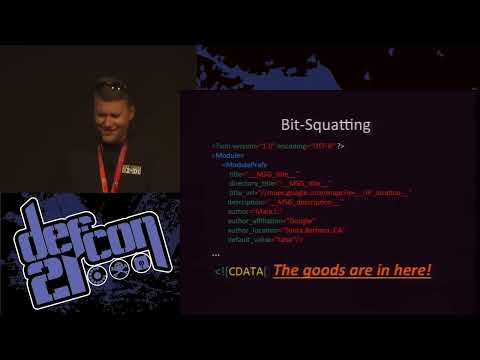
DEFCON 21 - DNS May Be Hazardous to Your Health - Robert Stucke
20K views • 13 years ago
Robert Stucke (bobhex)
A DEFCON 21 talk by Robert Stucke on DNS errors caused by single-bit flips, which lead to requests for misspelled domains. It shows real-world data on bitsquatting.
 1:05:39
The One-Decade Task: Putting std::atomic in CUDA. - Olivier Giroux - CppCon 2019
11K views • 7 years ago
CppCon
Olivier Giroux's CppCon 2019 talk recounts the roughly ten-year effort to bring std::atomic and the C++ memory model to CUDA GPUs, through ten stories from that work.
 59:56
Marty Lobdell - Study Less Study Smart
25.5M views • 15 years ago
Pierce College District WA
Psychology professor Marty Lobdell gives a one-hour lecture on how to study effectively, covering short focused sessions with breaks, study environment, note-taking and memory techniques. It was aimed at students who cram without improving.
 21:04
Apollo Guidance Computer Part 1: Restoring the computer that put man on the Moon
588K views • 7 years ago
CuriousMarc
The first episode of CuriousMarc's series restoring a real Apollo Guidance Computer, led by AGC expert Mike Stewart. They set up a makeshift lab in a Houston hotel room to open up a rare machine owned by a private collector.
 14:27
The Biggest Myth In Education
15.5M views • 5 years ago
Veritasium
Veritasium debunks the idea of learning styles, such as being a visual learner, with an interview with Daniel Willingham and a memory experiment. It argues that a multimodal approach helps everyone.
 6:30:32
The Caretaker - Everywhere At The End Of Time - Stages 1-6 (Complete)
40.2M views • 7 years ago
vvmtest
The complete six-stage album series Everywhere at the End of Time by The Caretaker, about 6.5 hours of music that depicts the progression of dementia through distorted, decaying old ballroom recordings.
 1:39:25
CppCon 2016: Herb Sutter “Leak-Freedom in C++... By Default.”
149K views • 10 years ago
CppCon
Herb Sutter's CppCon 2016 talk on lifetime safety in C++, aiming for code free of leaks and dangling pointers by default. It covers smart pointers, ownership, reference counting pitfalls and deferred reclamation resembling garbage collection.
 1:00:12
Pitfall Classic Postmortem With David Crane Panel at GDC 2011 (Atari 2600)
76K views • 15 years ago
GameSpot
David Crane, designer of Pitfall for the Atari 2600, gives a GDC 2011 postmortem on the game's design challenges. He covers how he fit a large world into the console's tiny memory. The session ends with Q&A.
 31:19
CppCon 2016: Nicholas Ormrod “The strange details of std::string at Facebook"
122K views • 10 years ago
CppCon
Nicholas Ormrod's CppCon 2016 talk on how Facebook optimizes std::string with its open-source replacement fbstring. It covers storage layout tradeoffs, small string optimization and memory allocation behavior.
 1:16:58
code::dive conference 2014 - Scott Meyers: Cpu Caches and Why You Care
231K views • 11 years ago
NOKIA Technology Center Wrocław
Scott Meyers explains how CPU caches work and why they matter for performance, covering cache levels, access speeds, associativity, and effects in multithreaded code. The focus is C++ and cache-aware, data-oriented programming.
 37:56
The Neuroanatomy of ADHD and thus how to treat ADHD - CADDAC - Dr Russel Barkley part 3ALL
1.3M views • 12 years ago
Adhd Videos
Dr. Russell Barkley lectures on the neuroanatomy of ADHD and how to treat it, linking executive function and working memory to the disorder. It is part 3 of a CADDAC series.
 1:01:51
Rant: Entity systems and the Rust borrow checker ... or something.
304K views • 8 years ago
Jonathan Blow
Jonathan Blow's hour-long livestreamed response to a RustConf 2018 closing keynote about entity systems in Rust. He argues that index-based entity systems amount to manual memory management that sidesteps the borrow checker, and he talks about friction for game developers.
 59:21
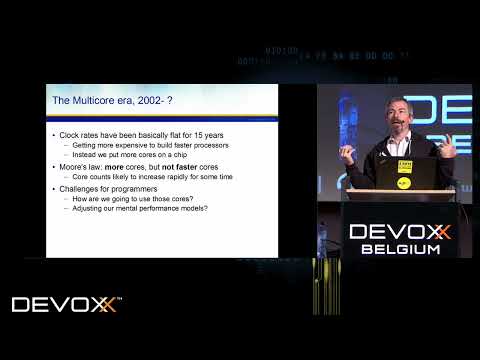
A Crash Course in Modern Hardware by Cliff Click
21K views • 9 years ago
Devoxx
Cliff Click walks through a small performance example on a modern out-of-order CPU. He covers pipelining, ILP, CISC vs RISC, multicore, and why cache misses and the memory subsystem dominate performance.
 1:05:59
Modern C and What We Can Learn From It - Luca Sas [ ACCU 2021 ]
130K views • 5 years ago
ACCU Conference
Luca Sas's ACCU 2021 talk on Modern C, a style of C and C-like C++ aligned with data-oriented design. It covers centralized memory management, zero-is-initialization, error handling and API design.
 2:09:42
Jeff Hawkins: Thousand Brains Theory of Intelligence | Lex Fridman Podcast #25
329K views • 7 years ago
Lex Fridman
Lex Fridman interviews Jeff Hawkins, founder of Numenta and author of On Intelligence, about the Thousand Brains Theory and reverse-engineering the neocortex. They also cover Hierarchical Temporal Memory and brain-inspired AI architectures.
 45:14
DEF CON 19 - Artem Dinaburg - Bit-squatting: DNS Hijacking Without Exploitation
4K views • 13 years ago
DEFCONConference
Artem Dinaburg's DEF CON 19 talk on bit-squatting, where DRAM bit flips cause DNS requests to go to domains one bit off from the intended one. It shows how hardware faults can be exploited for hijacking without any software exploit.
 48:36
The Charming Genius of the Apollo Guidance Computer - Brian Troutwine
170K views • 11 years ago
Erlang Solutions
Brian Troutwine's Code Mesh 2015 talk on the Apollo Guidance Computer. It covers the AGC's design, core rope memory, its interrupt and software behavior, and the pioneering engineering effort behind it.
 1:07:34
What Happens When Maths Goes Wrong? - with Matt Parker
3.3M views • 7 years ago
The Royal Institution
Matt Parker's Royal Institution talk based on his book Humble Pi, covering everyday mathematical mistakes and spurious patterns that went wrong in engineering and software. It mixes stand-up comedy with stories of coincidence and error.
 3:15
[TAS] [Obsoleted] GBC Pokémon: Yellow Version "arbitrary code execution" by Fracta[...] in 03:14.15
154K views • 13 years ago
TASVideosChannel
A tool-assisted speedrun of Pokemon Yellow on Game Boy Color that uses glitches and frame-precise inputs to make the game execute an arbitrary program. It was later obsoleted by an improved run.