creative process
 1:34:44
Jim Keller: Moore's Law, Microprocessors, and First Principles | Lex Fridman Podcast #70
742K views • 6 years ago
Lex Fridman
Lex Fridman interviews legendary chip architect Jim Keller about Moore's Law, microprocessor design, and first-principles thinking. Keller draws on his work at AMD, Apple, Tesla and Intel, discussing instruction sets, transistor budgets, and self-driving.
 11:13
1979: Will WORD PROCESSORS start a HOME WORKING revolution? | Past Predictions | BBC Archive
461K views • 4 years ago
BBC Archive
A 1979 BBC Nationwide report asking whether word processors and networked microprocessors could end office commuting. It shows early word processing and a woman working from home, with surprisingly prophetic predictions.
 18:18
I Tried Turning Games Into Text
571K views • 2 years ago
Acerola
Acerola explores building a shader that turns games into ASCII art, walking through techniques such as brightness mapping and edge detection to see whether it looks good.
Topic match · Creative coding & generative art 29:44
EEVblog #1341 - AMAZING $250,000 IBM Processor TEARDOWN!
714K views • 6 years ago
EEVblog
Dave Jones of EEVblog tears down a 1991 IBM 9121 thermal conduction module from a System/390 mainframe, a 63-layer ceramic hybrid module with 2772 pins worth about $250,000, and demonstrates a BGA desoldering technique.
 1:00:49
The Art of Code - Dylan Beattie
4.9M views • 6 years ago
NDC Conferences
Dylan Beattie's NDC London talk on code written for art, fun and curiosity rather than utility. It includes quines, live music programming with Sonic Pi, and a memorable closing.
Topic match · Creative coding & generative art 3:29:21
How Sugar & Processed Foods Impact Your Health | Dr. Robert Lustig
5.1M views • 2 years ago
Andrew Huberman
A long Huberman Lab podcast episode with Dr. Robert Lustig on the calories-in, calories-out model and how sugar, fructose, fiber and processed foods affect insulin, liver and metabolic health.
 1:35:45
[FOSSi Dial-Up] Tim Ansell - Skywater PDK: Fully open source manufacturable PDK for a 130nm process
34K views • 6 years ago
FOSSi Foundation
Tim Ansell presents the SkyWater PDK, a fully open source manufacturable process development kit for a 130nm process, as the first FOSSi Dial-Up talk. He covers its role in a fully open chip design flow.
 11:58
Melt your circuit boards
471K views • 4 years ago
mitxela
mitxela shows his KiCad plugin that rounds PCB tracks to give circuit boards organic, melted-looking layouts instead of rigid geometric ones.
Topic match · Creative coding & generative art 20:38
Modular Micro-Reactors – The Future of Nuclear Energy?
169K views • 6 years ago
Illinois EnergyProf
Professor Ruzic explains modular micro-reactors: self-contained nuclear units with passive safety whose fuel lasts about 20 years. He covers their use for process and district heat and where they can compete with diesel generation.
 27:48
How are Microchips Made? 🖥️🛠️ CPU Manufacturing Process Steps
11.9M views • 2 years ago
Branch Education
Branch Education walks through a semiconductor fab and the dozens of steps used to turn silicon wafers into microchips, with 3D animation. It covers lithography, deposition and etching at a high level.
 11:05
Updated BP Texas City Animation on the 15th Anniversary of the Explosion
2.3M views • 6 years ago
USCSB
The US Chemical Safety Board's updated animation of the 2005 BP Texas City refinery explosion, which killed 15 workers. It was released ahead of a process safety training application.
 20:08
14nm and 7nm are NOT what you think it is - Visiting Tescan Part 3/3
296K views • 6 years ago
der8auer
Der8auer visits Tescan and uses an electron microscope to compare real transistor sizes on Intel 14nm and AMD 7nm chips. It shows that process node names do not match physical measurements.
 31:06
Jim Keller - Moore's Law in the age of AI Chips
33K views • 6 years ago
Matroid
Jim Keller's talk at the 2020 Scaled Machine Learning conference on Moore's Law in the age of AI chips. He compares scalar, vector and GPU-style parallel approaches to computation.
 17:22
AWS re:Invent 2020: Working backwards: Amazon’s approach to innovation
80K views • 5 years ago
AWS Events
An AWS re:Invent session explaining Amazon's Working Backwards process, where teams start from customer needs and write a press release and FAQ (PR-FAQ) before building. It covers the five customer questions that frame the process.
 24:46
Painting a Character with Maths
458K views • 5 years ago
Inigo Quilez
Inigo Quilez live-codes a cartoon character painting entirely from math, using signed distance fields in a Shadertoy shader. He explains each step of building the image from formulas.
Topic match · Creative coding & generative art 42:00
I painted a Landscape with Mathematics
812K views • 4 years ago
Inigo Quilez
Inigo Quilez live-paints a mountain landscape using only math in a shader, building up from a basic polynomial noise surface through fractal terrain, lighting and atmosphere. The code runs in real time on Shadertoy so viewers can edit it as they follow along.
Topic match · Creative coding & generative art 17:54
Coding Adventure: Ant and Slime Simulations
2.2M views • 5 years ago
Sebastian Lague
Sebastian Lague explores an ant-inspired algorithm and simulates ant and slime mold behavior, using compute shaders. Source code for both simulations is available.
Topic match · Creative coding & generative art 27:29
Herbert Wolverson - Procedural Map Generation Techniques
153K views • 6 years ago
Roguelike Celebration
Herbert Wolverson's Roguelike Celebration 2020 talk surveying procedural map generation techniques, including integration of hand-crafted prefabs and vaults.
Topic match · Creative coding & generative art 21:46
Surface-Stable Fractal Dithering Explained
646K views • 1 year ago
runevision
Rune Skovbo Johansen explains Surface-Stable Fractal Dithering, a technique he invented and released as open source. It makes dithering stick to 3D surfaces and covers the experiments and shortcomings along the way, inspired by Return of the Obra Dinn.
Topic match · Creative coding & generative art 53:41
How I animate 3Blue1Brown | A Manim demo with Ben Sparks
3.3M views • 2 years ago
3Blue1Brown
Grant Sanderson of 3Blue1Brown shows his workflow for animating math videos with Manim, with Ben Sparks. He codes scenes live, including a Lorenz attractor, and walks through example scenes.
Topic match · Creative coding & generative art 2:41
Generative AI for Krita - With ControlNet
223K views • 3 years ago
Acly
A short demo of an open-source Krita plugin that uses Stable Diffusion to generate and edit images in place. It adds ControlNet scribble and line-art support. You select an area, push a button, and new matching content appears.
Topic match · Creative coding & generative art 1:43
Google Maps Hacks by Simon Weckert
3.6M views • 6 years ago
Simon Weckert
An art project by Simon Weckert in which 99 smartphones pulled in a handcart create a fake traffic jam on Google Maps. A green street shows as red, which diverts cars to other routes.
Topic match · Creative coding & generative art 28:23
The Fast Fourier Transform (FFT): Most Ingenious Algorithm Ever?
2.3M views • 5 years ago
Reducible
Reducible's visual walkthrough of the Fast Fourier Transform, motivated by polynomial multiplication. It shows how the FFT's key ideas can be discovered by asking the right questions.
 26:33
The Most Underrated Algorithm
10.8M views • 4 years ago
Veritasium
Veritasium tells the story of the Fast Fourier Transform, from its use in detecting nuclear tests to Cold War politics, and how it could have changed the arms race. It includes a short, intuitive explanation of what the Fourier transform does.
 56:51
How Does Kodak Make Film? (Kodak Factory Tour Part 1 of 3) - Smarter Every Day 271
3.8M views • 4 years ago
SmarterEveryDay
Destin Sandlin of Smarter Every Day tours a Kodak factory to show how photographic film is manufactured. This is part one of a three-part series covering the large-scale coating and production process.
 18:35
We Are The Art | Brandon Sanderson’s Keynote Speech
579K views • 9 months ago
Brandon Sanderson
Brandon Sanderson's keynote on AI-generated art, arguing that the artistic process and the journey matter more than the finished product. He explains why he rebels against generative AI in creative work.
 20:47
Decaf Explained
2.1M views • 2 years ago
James Hoffmann
James Hoffmann explains how decaf coffee is made, how the decaffeination processes differ, and why decaf is roasted and stales differently. He also discusses decaf quality and health questions.
 1:00:46
"Design in Practice" by Rich Hickey
65K views • 3 years ago
ClojureTV
Rich Hickey's Clojure Conj 2023 talk on design in practice, covering problem statements, decision matrices, choosing precise words and making decisions in a team.
 1:06:20
USENIX ATC '21/OSDI '21 Joint Keynote Address-It's Time for Operating Systems to Rediscover Hardware
46K views • 5 years ago
USENIX
Timothy Roscoe of ETH Zurich delivers the joint USENIX ATC/OSDI 2021 keynote arguing that operating systems must reckon with modern hardware, which is a heterogeneous collection of processors, firmware and coprocessors rather than a simple machine. It shows how much runs below and beside Linux.
 53:17
Starbase Tour with Elon Musk [PART 1 // Summer 2021]
7.1M views • 5 years ago
Everyday Astronaut
Tim Dodd of Everyday Astronaut tours SpaceX's Starbase with Elon Musk as guide. They cover the high bay, grid fins, Raptor V2, the HLS lander and stage separation, and Musk explains his engineering management process.
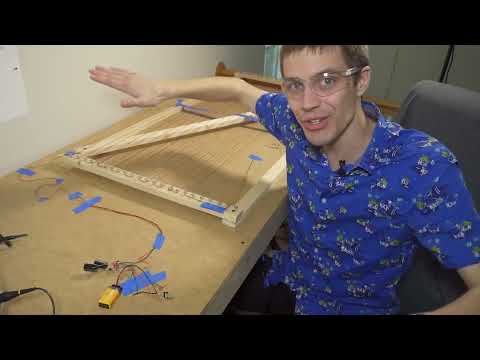 26:29
Watch electricity hit a fork in the road at half a billion frames per second
3M views • 2 years ago
AlphaPhoenix
AlphaPhoenix uses a custom high-speed measurement setup to watch voltage waves travel down wires and split at a fork. It answers how electricity knows where to go and how quickly that process happens.
 35:33
How does Computer Memory Work? 💻🛠
5.5M views • 4 years ago
Branch Education
A 36-minute animated deep dive from Branch Education into how DRAM works. It shows how memory connects to the CPU and how billions of bits are stored in nanoscale capacitor cells. It also covers why DRAM sits between SSDs and the processor.
 5:46
"Z2" - Upgraded Homemade Silicon Chips
2.5M views • 5 years ago
Sam Zeloof
Sam Zeloof shows the upgraded second iteration of his homemade silicon integrated circuit fabrication process, producing chips with around a thousand transistors in his garage. It is a short overview of what the home fab can now do.
 25:34
How To Make Infrared Cooling Paint (Electricity Free Air Conditioning)
1.2M views • 4 years ago
NightHawkInLight
NightHawkInLight shows how to make ultra-white radiative paint that cools surfaces below ambient temperature without electricity. He walks through the research papers and the household-materials process.
 38:31
The $200M Machine that Prints Microchips: The EUV Photolithography System
2.4M views • 1 year ago
Branch Education
Branch Education's animated deep dive into ASML's EUV photolithography machine and how it prints nanometer-scale transistors onto chips. It covers the system's components and the process of chip manufacturing.
 43:41
COVID-19 Vaccines: MODERNA | PFIZER/BIONTECH | ASTRAZENECA
6.8M views • 5 years ago
Ninja Nerd
A Ninja Nerd whiteboard lecture on the Moderna, Pfizer/BioNTech and AstraZeneca COVID-19 vaccines. It covers how each works, the preclinical and phase I-III trial process, and Operation Warp Speed.
 11:27
The Commodordion
531K views • 4 years ago
lftkryo
Linus Akesson demonstrates the Commodordion, a fully functional 8-bit accordion built around Commodore 64 hardware with bellows made of floppy disks. He performs Scott Joplin's Maple Leaf Rag and tells the story of the build.
 1:01:08
1. A strange determinant
30K views • 5 years ago
Timothy Gowers
Timothy Gowers thinks aloud, in real time, as he tries to understand why Pascal's determinant equals 1. He does not fully solve it in this episode, but shows his exploratory process.
 1:03:23
The Only Famous Motherboard
266K views • 2 years ago
Cathode Ray Dude - CRD
Cathode Ray Dude's hour-long retrospective on the ABIT BP6, the dual-Celeron motherboard. He covers early multiprocessing, its legend, a build, running NT 4, benchmarks and the pros and cons of early SMP.
 56:03
A Tour of Prolog
33K views • 4 years ago
The Power of Prolog
Markus Triska tours Prolog's most distinctive features, including its use as a database and query language, rule processing, constraint solving and compile-time rewriting. It also covers concise meta-interpreters.