information processing
 13:43
Why Quantum Information is Never Destroyed
715K views • 8 years ago
PBS Space Time
A PBS Space Time episode asking whether the universe's information can ever truly be lost, tying quantum mechanics, determinism and black holes together. It sets up the black hole information paradox.
 12:31
The Superheterodyne Radio: No really, that's its name
987K views • 7 years ago
Technology Connections
Technology Connections explains why the superheterodyne radio has its name and how mixing frequencies lets it tune stations well. It walks through the underlying wave phenomena and algebra and why the design solved a hard tuning problem.
Topic match · Information theory & signal processing 15:30
The Black Hole Information Paradox
1.1M views • 8 years ago
PBS Space Time
PBS Space Time episode on the black hole information paradox, covering how black holes seem to destroy information, the no-hair conjecture and the proposed role of the event horizon. It is part of a series on black holes.
 19:42
But what is the Fourier Transform? A visual introduction.
12.6M views • 8 years ago
3Blue1Brown
3Blue1Brown's animated visual introduction to the Fourier Transform, showing how a signal breaks into frequency components.
Topic match · Information theory & signal processing 18:07
The more general uncertainty principle, regarding Fourier transforms
2.3M views • 8 years ago
3Blue1Brown
3Blue1Brown shows how the uncertainty principle arises from Fourier transforms. A wave packet cannot be narrow in both position and frequency, so the principle is a property of waves rather than of measurement.
Topic match · Information theory & signal processing 4:32
The Visual Microphone: Passive Recovery of Sound from Video
1.9M views • 12 years ago
Abe Davis's Research
MIT researchers show that sound can be recovered from silent video by analyzing tiny vibrations in objects such as a potato chip bag. It works even with consumer cameras by using rolling shutter.
Topic match · Information theory & signal processing 15:12
JPEG DCT, Discrete Cosine Transform (JPEG Pt2)- Computerphile
697K views • 11 years ago
Computerphile
Mike Pound explains the discrete cosine transform and how it underpins JPEG compression. It is part two of Computerphile's JPEG series.
Topic match · Information theory & signal processing 18:31
Fourier Optics used for Optical Pattern Recognition
103K views • 6 years ago
Huygens Optics
Huygens Optics explains the Fourier transform and shows how a lens performs one optically. A DLP projector is used as a Fourier filter to do simple pattern recognition on lithographic character patterns.
Topic match · Information theory & signal processing 9:37
Characters, Symbols and the Unicode Miracle - Computerphile
2.1M views • 13 years ago
Computerphile
Tom Scott explains for Computerphile how Unicode and UTF-8 grew out of messy older character encodings to become the web's standard. It covers why the design works and how it handles worldwide text.
Topic match · Information theory & signal processing 4:20
Why Snow and Confetti Ruin YouTube Video Quality
10.4M views • 10 years ago
Tom Scott
Tom Scott explains why confetti and snow wreck video quality, using interframe compression and bitrate. He demonstrates it live by changing the quality on screen.
Topic match · Information theory & signal processing 9:51
Justin Bieber 800% Slower
4.4M views • 16 years ago
turinpt2
A Justin Bieber song slowed down 800% with the PaulStretch program, turning a pop track into a long ambient drone.
Topic match · Information theory & signal processing 4:01
Onslaught - Bad Apple 64 - C64 Demo
71K views • 12 years ago
RetroDemoScene
Onslaught's Bad Apple 64 is a Commodore 64 demo that streams over 2000 frames of the Bad Apple animation from a single disk side at 12fps, with each frame packed to around 70 bytes.
Topic match · Information theory & signal processing 9:16
Floating Point Numbers - Computerphile
2.5M views • 12 years ago
Computerphile
Tom Scott explains for Computerphile how floating point numbers work, why moving the binary point is fast, and why it handles money badly.
Topic match · Information theory & signal processing 5:52
[Equation] - Aphex Twin Spectrogram
476K views • 17 years ago
HappyQuark
A spectrogram analysis of Aphex Twin's track commonly called [Equation] from Windowlicker, rendered from a lossless version. At about 5:30 the spectrogram reveals an image of Richard D. James's face.
Topic match · Information theory & signal processing 6:26
Adobe MAX 2011 - Photoshop Image Deblurring sneak
1.8M views • 15 years ago
Peter Elst
A six-minute clip of Adobe's MAX 2011 sneak peek showing a Photoshop prototype that removes motion blur from photos. The audience reacts with astonishment as blurry images become legible.
Topic match · Information theory & signal processing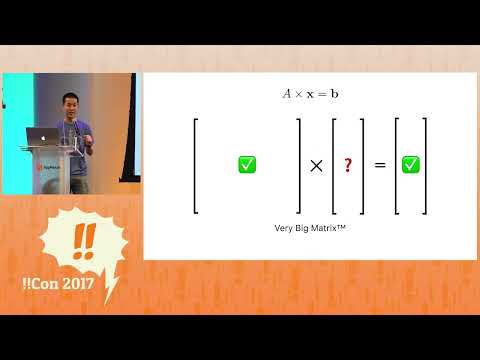 11:47
!!Con 2017: HDR Photography in Microsoft Excel?! by Kevin Chen
119K views • 9 years ago
Confreaks
A short conference talk from !!Con 2017 in which Kevin Chen explains the HDR imaging algorithm from a foundational paper, framing it as a system of linear equations, and implements it in a Microsoft Excel spreadsheet. No prior image processing knowledge is needed.
 12:40
Colonel JD AI Codec Conversation MGS2 HD
1.7M views • 13 years ago
Louie V
The final codec conversation from Metal Gear Solid 2, in which the AI 'Colonel' explains that the Patriots filter out junk information and curate truth for humanity. It plays as a dark meditation on information overload, manipulation and shared reality.
 11:32
The Internet is Worse Than Ever – Now What?
9.1M views • 2 years ago
Kurzgesagt – In a Nutshell
A Kurzgesagt video arguing that social media's problem is information flooding and tribal polarization. It suggests a return to smaller online communities and more in-person interaction.
 17:01
Your Brain Hallucinates Your Conscious Reality | Anil Seth | TED
12M views • 9 years ago
TED
Neuroscientist Anil Seth argues in this TED talk that perception is a controlled hallucination: the brain constantly predicts the world and our shared agreement is what we call reality. He also touches on the construction of the self.
 16:26
Dr. Oz and Nutritional Supplements: Last Week Tonight with John Oliver (HBO)
19.2M views • 12 years ago
LastWeekTonight
John Oliver's Last Week Tonight segment takes on Dr. Oz and the dietary supplement industry. It explains what is problematic about both, with a comedic wrap-up.
 18:18
I Tried Turning Games Into Text
571K views • 2 years ago
Acerola
Acerola explores building a shader that turns games into ASCII art, walking through techniques such as brightness mapping and edge detection to see whether it looks good.
 4:14
Computer Color is Broken
4.3M views • 11 years ago
minutephysics
MinutePhysics explains that computers store brightness nonlinearly, so blurring and blending colors in raw RGB gives wrong, dark results. It shows why mixed colors, such as in gradients, look off.
 4:27
Climate Change Debate: Last Week Tonight with John Oliver (HBO)
9.1M views • 12 years ago
LastWeekTonight
A short Last Week Tonight segment where John Oliver stages a statistically representative climate debate, with Bill Nye facing a crowd of dissenters. It satirizes false balance in media coverage.
 18:24
The Holographic Universe Explained
3.5M views • 7 years ago
PBS Space Time
A PBS Space Time episode explaining the holographic principle: the idea that our 3+1 dimensional universe may be described by information on a lower-dimensional boundary. It walks through black hole entropy and the AdS/CFT correspondence.
 18:57
Manipulating the YouTube Algorithm - (Part 1/3) Smarter Every Day 213
2.7M views • 7 years ago
SmarterEveryDay
Part 1 of Smarter Every Day's three-part series on manipulating the YouTube algorithm. It features Renee DiResta and examples of how social media platforms can be manipulated.
 9:52
AI Slop Is Destroying The Internet
11.4M views • 1 year ago
Kurzgesagt – In a Nutshell
Kurzgesagt examines how AI-generated content is flooding the internet, from video and music to news and books. It looks at how this makes verifying what is real harder.
 17:46
Why do Biden's votes not follow Benford's Law?
3.7M views • 5 years ago
Stand-up Maths
Matt Parker examines claims that Biden's 2020 vote counts violate Benford's Law, explaining the law and why it often does not apply to precinct-level election data.
 5:22
Dr.Christina Sanchez explains how cannabis kills cancer cells (MORE at cureyourowncancer.org)
240K views • 12 years ago
Lincoln Horsley
A short clip of molecular biologist Cristina Sanchez describing her lab research on how THC affects cancer cells. It is uploaded on a channel promoting cannabis as a cancer treatment.
 5:01
How It's Made - Canola Oil
4.5M views • 14 years ago
Panos Egglezos
A short 'How It's Made' television segment showing the industrial process of turning canola seed into cooking oil. It walks through pressing, solvent extraction and refining steps.
 11:24
The Tube Map nearly looked very different
2.6M views • 4 years ago
Map Men
Map Men's Jay Foreman tells the story of how the London Tube map nearly looked very different, including Harry Beck's design and TfL's initial rejection of it. A short, witty history of a design icon.
 4:26
A real, not-clickbaity, average Chinese wet market
909K views • 6 years ago
Chinese Cooking Demystified
Chinese Cooking Demystified shows an ordinary, everyday Chinese wet market to counter sensationalized coverage during the early pandemic, with a pinned comment adding nuance.
 14:40
How the Quantum Eraser Rewrites the Past | Space Time | PBS Digital Studios
2.9M views • 10 years ago
PBS Space Time
PBS Space Time explains the quantum eraser experiment, in which erasing which-path information appears to reverse causality in a double-slit setup. It discusses what this means for quantum mechanics.
 4:32
Web 2.0 ... The Machine is Us/ing Us
12.1M views • 19 years ago
Michael Wesch
Michael Wesch's five-minute video about Web 2.0, showing how the read/write web, XML and user-generated content change how people create and share information.
 9:05
Beware online "filter bubbles" | Eli Pariser
1.7M views • 15 years ago
TED
Eli Pariser's TED talk argues that personalized web services trap users in filter bubbles, limiting exposure to challenging information. He says this is bad for individuals and for democracy.
 12:32
Protecting Privacy with MATH (Collab with the Census)
451K views • 7 years ago
minutephysics
minutephysics, in collaboration with the US Census Bureau, explains differential privacy and why the 2020 census adds noise to protect individuals' data. It walks through how statistics can leak private information.
 6:50
KGB defector Yuri Bezmenov's warning to America (1984)
2.9M views • 6 years ago
Offensive Freedom
A short clip of former KGB defector Yuri Bezmenov in 1984 describing Soviet ideological subversion of Western societies. It is a political commentary excerpt from his longer lecture.
 4:42
Why Your Webcam Still SUCKS!
552K views • 6 years ago
Techquickie
A short Techquickie explainer on why laptop webcams are much worse than phone cameras. It covers sensor size, image processing, and the interface differences between laptops and phones, with input from a Logitech engineer.
 8:52
Revealed: ExxonMobil’s lobbying war on climate change legislation
243K views • 5 years ago
Channel 4 News
Channel 4 News reports on undercover Greenpeace footage of an ExxonMobil lobbyist describing efforts to weaken climate legislation. Exxon disputes the claims.
 14:05
Userbenchmark - the April Fools that never ends
2.5M views • 5 years ago
2kliksphilip
2kliksphilip examines UserBenchmark, a hardware comparison site known for strongly biased, pro-Intel writing. The video explains the site's credibility problems and points viewers to better sources for CPU and GPU information.
 15:20
The thrilling potential of SixthSense technology | Pranav Mistry
5.5M views • 16 years ago
TED
Pranav Mistry demos SixthSense, a wearable device that projects information onto the physical world and lets people interact with data through gestures. He also shows a paper "laptop" and says he will open-source the software.